
This Year’s Easter Jeep Safari Concepts are Cool, But 4 Stood Out
Don’t get me wrong: all of the Easter Jeep Safari concepts are visually captivating. But four spoke directly to my dear ol’ heart.

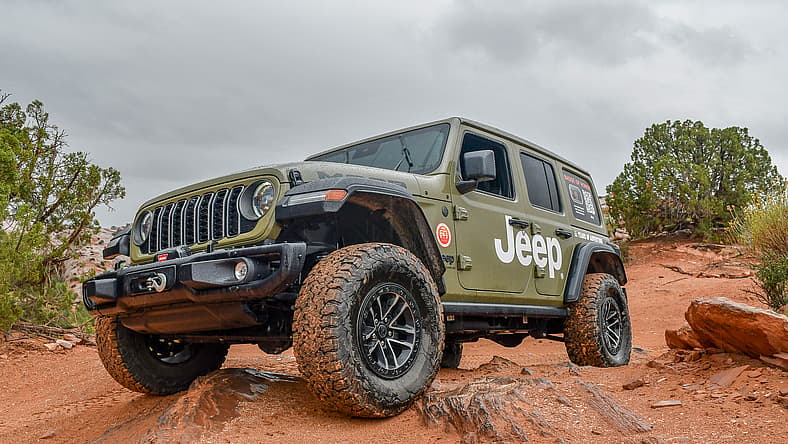
When I woke up on the morning of April 1, 2026, I immediately texted my husband to wish him a happy sixth wedding anniversary. The rain tap danced against my window and a single thought popped into my head: rain means mud, and mud makes for excellent photos of the 2026 Easter Jeep Safari concepts I was scheduled to drive that morning.
All but two concepts were parked on the muddy, wet sand, and while all of them were impressive to look at, each came with an amazing origin story, told to us by the Jeep execs who designed them. But four of them: Buzzcut, Anvil, Red Rock, and Commander, truly stood out to me.
Driving them through a section of Moab’s esteemed Fins & Things only boosted my affection for them. Here’s how my morning went.
This story is 100% human-researched and written based on actual first-person knowledge, extensive experience and expertise on the subject of cars and trucks. I was Jeep’s guest for this event, but all opinions and impressions are my own.
First Is Buzzcut, the Most Masculine Jeep of the Bunch

Buzzcut was one of the first concepts that stood out to me because it was Jeep’s bright, ostentatious Vitamin C color with tasteful matte black accents on the roof, doors, and grille. The roof was two inches shorter than it would normally be, giving it what Jeep calls a “fastback-style” roofline. In the back, I saw that it was sloped, making it look like a Hot Wheels or Matchbox car.
Of course, it wouldn’t be at Easter Jeep Safari if there weren’t any other modifications. It had a two-inch lift, Bilstein shocks, a visible (and handsome) snorkel attached to a cold air intake in the company’s 2.0-liter inline four-cylinder engine. A winch bumper was installed up front, a steel bumper was installed in the back, and front-facing exterior lights made it look like ready for any action.
On the inside, the rear seats were deleted to make room for a locking storage compartment, and hand grips were installed to access storage on the reinforced roof, too. It’s designed for longer excursions, which is why it was only lifted by two inches and poised on 37-inch tires. The front seats, steering wheel, and dashboard all had Vitamin C colored accent stitching to complete the aesthetic, and I adored it.
As the owner of a two-door Wrangler, I immediately gravitated towards it. But it was the color combination and sloped roof that made me fall for it. Rock crawling with it made me swoon for it. If Jeep ever put this into production, the take rate would be insane.
The Commander Was Large and In Charge, But Insanely Capable

At first, the Commander concept, a lifted Grand Wagoneer on larger all-terrain tires, didn’t do anything for me. Even though it had off-road lighting on the roof, and dark gold topographical patterns on top of shiny black paint. The Grand Wagoneer is a large barge, and I’m normally turned off by SUVs that large. But putting the heifer in 4Lo and crawling up a few sections of Fins & Things certainly changed my perspective.
Yes, the interior is fancy, it’s wide, it’s long, and it’s insanely comfortable. But I was thoroughly impressed with what the land yacht conquered when I put it to the test. Yes, I did need a spotter because the front camera option was missing, but it felt just as steady and stable as the Gladiator once it was in 4Lo.
A Grand Wagoneer that I can haul the family in, and go rock crawling in? What’s not to love?
The ANVIL 715 Was the Best-Looking (And Sounding) Concept

There was another Jeep Wrangler there with a 392 Hemi under the hood, but what really, truly captured the sound and feel of the V8 is the ANVIL 715 concept. The exterior color was the first thing I noticed. The second was the customized, military-inspired overlander with a hood inspired by the brand’s past designs. It was mounted on the body of a four-door Wrangler Unlimited Rubicon, and it was built to show people how a Wrangler can be modified to be a tasteful overlander that shows a lot of respect to the company’s roots.
The hood and face immediately reminded me of the old Wagoneers of the 1960s, or the old SJ trucks, and that’s because those looks inspired the concept. But it wasn’t just built to look good. The ANVIL 715 concept had interior modifications, too, like updated (and incredibly comfortable) seats that hugged me and helped keep me steady while rock crawling, a gorgeous custom dashboard colored like the exterior, and more storage options in the trunk. The rear seats were switched up, too, and like the front seats, colored to match the paint color.
I loved that it blended the looks of classic Jeep trucks while keeping things modern and more Wrangler-like elsewhere. It’s more than just a restomod—it was a true salute and nod to the brand’s history, while showing just what they’re capable of when it comes to building off-roaders.
Then There Was the Red Rock Gladiator, Which Had the Coolest Story

I love a tastefully built Gladiator, and this was just that. It was lifted, standing on taller tires, with bed modifications that maximized storage, like a sliding tray and storage boxes on the bed rack. But it was why they built the Red Rock concept—as well as what they did with it after Easter Jeep Safari—that really sealed the deal for me.
The reason it’s called Red Rock is because of a local off-roading group called Red Rock 4-Wheelers. For decades, the group not only organized and led trail rides with locals with Jeeps (and other off-roaders), but they also organized trail clean-up events to help maintain and protect the region’s famous trails. They used their own vehicles, tools, members, and resources to do that, so Jeep decided to give back.
Executives met with George Schultz and asked, “Hypothetically, if we built you a Jeep to use to maintain these trails, what would you need?” During that meeting, they heard incredible stories of how the group came to be, incredible things the group has done for Moab, and the fact that he and his father mapped Hell’s Revenge—one of Moab’s toughest and most popular trails.
The Interior Was Wholesomely Customized, too

So, Jeep took what Schultz said to heart and built a Gladiator, paying close attention to what they were told. In the interior, newspaper clippings of the stories they were told were printed onto fabric and sewn onto the removable roof panels, as well as a hand-drawn map of Hell’s revenge on the panels over the rear seats. I was told by the man who led the project that when they presented the truck to Schultz, he was brought to tears.
But that’s not even the best part. When the event is over, the Red Rock Gladiator—which came with decals bearing the group’s adorable logo—is being donated by Jeep to the group to use in trail cleanups and events. The build itself isn’t as extensive as some of the other concepts, but it was the story—from beginning to the conclusion—that impressed me the most.
This Year’s Concepts Were My Favorites Compared to Other Years
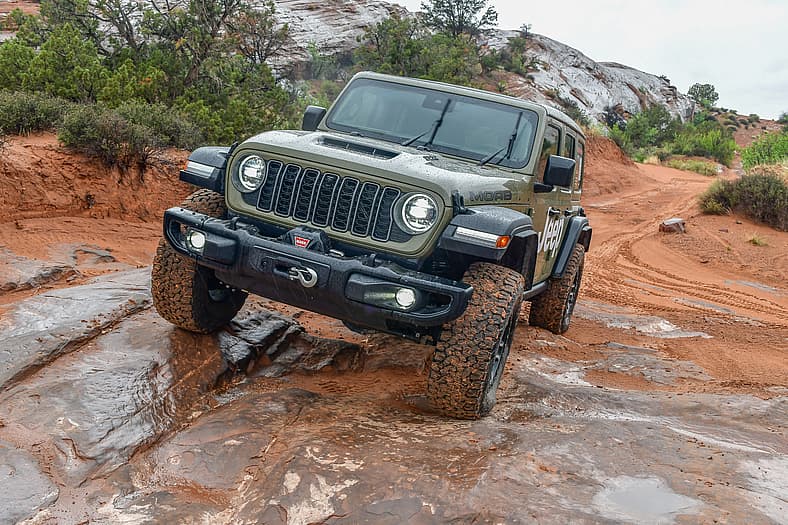
I always look forward to seeing pictures of Jeep’s concept for Easter Jeep Safari. I always had a favorite, but this year was the first year I’ve had multiple favorites. And that’s because this year, it seemed like the concepts came with cooler, more fun backstories that made them feel more like concepts, and more like fun ideas, stories, and missions come to life.
Driving them only made them more appealing to me. I loved Rewind, which played into a fun, purple 80s theme, and Pioneer, which pulled on my heartstrings because I love old XJ Cherokees. But Red Rock’s story was just so cool.

More About:Car Culture