



Here’s a confession: I’ve spent years writing about cars, testing them, reviewing their features, and analyzing their technology. But until recently, I’d never actually worked on one. Not really. I can change my cabin filters, add windshield wiper fluid, and change my windshield wipers (yes, these are things I’ve done), but the moment something requires getting under the car or using specialized tools? That’s where my expertise ends, and my anxiety begins.
So, when I got the chance to spend a day as a Ford technician to learn about winter prep on cars at All American Ford of Paramus, New Jersey, I grabbed it. What I learned wasn’t just about cars. It was about something far more critical for moms like me: confidence in understanding what my family’s car actually needs when it comes to winter car care, especially as winter rolls in.
This story is 100% human-researched and written based on actual first-person knowledge, extensive experience, and expertise on the subject of cars and trucks.
Getting Dirty: What a Real Multi-Point Inspection (MPI) Actually Looks Like


Walking into the service bay with Russ, my certified Ford technician guide for the day, I expected to feel out of place. I didn’t. What I felt instead was genuinely curious, like I was being let in on a secret that I should’ve been told years ago.
Russ walked me through a comprehensive multi-point inspection, the kind that takes about 30 minutes and costs you nothing if you’re smart about your maintenance plan. But here’s the thing: he didn’t just talk me through it. He let me actually do it.
All manufacturers do it differently, but at Ford, dealerships have their technicians look at a variety of different things, like a car’s fluids, belts, battery, and filters. On the underside, a technician will inspect the exhaust system, suspension, steering, important engine seals for leaks, the tires (pressure, tread, wear), and brakes (pads, rotors, lines), plus exterior/interior lights, wipers, and overall safety features, using a checklist to flag items needing service, repair, or replacement. This is what Russ had in store for me. And you can bet I was nervous.
They look for any possible indication that there is, or might be a problem. That’s why it’s always important to get it checked out.
First Order of Winter Car Care Business Was Exterior Lighting

Russ’s first step surprised me. He turned on the car. Not to drive it, but to check every single light. Headlights. Brake lights. Hazards. All of them. Then we did a walk-around to confirm everything was working visually. It sounds simple, but it’s important. Broken lights are a safety and a legal issue, a non-negotiable, especially before winter driving.
After all, if it’s snowing, raining, or it’s foggy, you want the car in front of and behind you to be able to see you clearly. The best way to accomplish that is to make sure all of your lights, but especially your exterior lights, are working as they should. Including blinkers and hazard lights to make sure they’re flashing properly. You should do this before a road trip, too.
Then Comes What You Can (Kind Of) Handle


Next, the windshield wipers. I already know how to do this, and I actually change mine myself when needed. But Russ showed me the proper way to check them: run your fingers across the rubber blades and look for tears or uneven wear.
If you feel anything irregular, replace them. We also topped off the wiper fluid, something absolutely everyone should be able to do themselves. Winter-grade, or anti-freeze wiper fluid, matters more for visibility than you’d think.
Winterized fluid helps break up ice as well as prevent more from forming, which comes especially in handy during storms. It also keeps your rubber lines from freezing, too.
Next Was Checking the Engine Filters

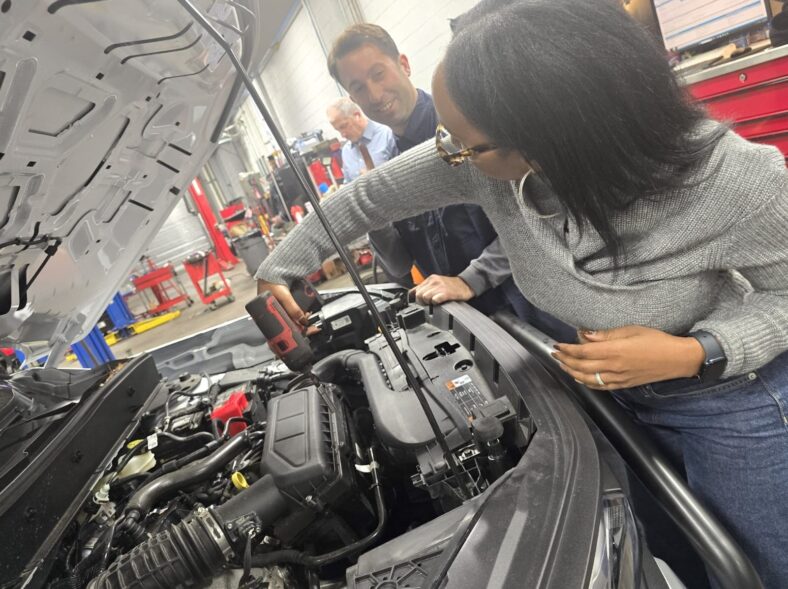
Then we moved to the engine filter. At 5’2.5″, I definitely could have used a stool to reach it properly. So, I did my best stretching on my toes while Russ guided my hand to reach the screws. The last one, towards the back, was the hardest to access. That’s where Russ’s experience showed: he gently guided my hand into the exact position I needed to get it loose.
The engine air filter gets attention around 15,000 to 30,000 miles, depending on driving conditions: dusty areas, heavy traffic, or rough terrain may mean you need to change it closer to 5,000-10,000 miles. A good habit is to check your air filter after any oil change to make sure it’s not visibily dirty or clogged.
A dirty or clogged filter can have negative effects on an engine, like reduced fuel economy, slower acceleration, or overall poor performance. I actually loosened the bolts and inspected it myself. Genuinely simple, but weirdly empowering, even if I needed a little guidance for that stubborn back screw.
Don’t Forget to Inspect and Clean the Battery!

Next came the battery. This seems obvious for winter, but many people skip it, and that’s a mistake. Cold weather makes your car demand more energy just to start, which puts severe strain on your battery. Most batteries have chemicals in them that can become thicker in the winter, making it more difficult, too.
Russ showed me how to look for corrosion on the terminals: buildup that looks crusty or white. Clean terminals mean better performance. But more importantly, he used an electric battery tester to actually measure the battery’s real health and capacity. It provides hard data on whether your battery can handle the demands of cold starts. You can’t know if a battery is truly failing just by looking at it. The tester tells you the truth. Many places can test your battery for free, too.
Here’s something else Russ emphasized: if you need to buy a new battery, check the manufacturer’s date before you purchase it. If that battery is more than 2 years old, its life is already reduced. You want a battery that was manufactured recently, ideally within the last year of your purchase. A year from purchase should be your maximum. Most people (me, I’m most people) don’t know about this, and they end up with a “new” battery that’s already halfway through its useful life.
A failing battery in January is worse than almost any other car problem—and knowing its condition before winter arrives is game-changing.
The Most Important Part on a Car: The Tires


Before looking underneath, we checked the tire treads. This is where Russ introduced me to the slime tread depth gauge, a small tool you can buy yourself for under $6. Russ was emphatic: this is better than the penny test. It’s more accurate. It gives you a precise measurement.
Here’s why this matters: tire tread directly impacts winter traction. The gauge shows you exactly how much tread you have left and compares it to minimum safe levels. No guessing. If your tire tread isn’t where it should be, it’s a matter of safety to get new ones. And tire with unsafe tread depth isn’t a safe one. Don’t take the risk.
Then Russ taught me how to remove the tire. Yes, I actually took a tire off the car. With tools. While it was on the lift. And I didn’t drop it. You don’t have to lift the car or remove the tire at home to inspect it, though. You just need the tool.
With the tire removed, Russ showed me what to check: suspension movement, any breaks in the suspension rods, looseness in the ABS wires, and any signs of damage. He used a brake gauge tool, color-coded for clarity. Green means good. Yellow means you’re approaching replacement time. Red means change immediately, don’t wait. The brake pads on that Bronco were in the green zone, but you could see exactly how much life they had left.
I Was So Nervous Checking the Underside of a Car


Then came the moment I was especially nervous about: looking under the car. I’ve seen the videos. Animals. Rodents. Things that shouldn’t be there, falling out when you least expect them. I did NOT want that to happen.
Thankfully, we were in the clear. But from underneath, you can see things that matter: rust accumulation, leaks, suspension components, brake lines, and undercarriage damage. This is where road salt does its real damage.
Russ was emphatic: after snow, get your undercarriage washed. Not just for appearance. Salt corrodes metal. Over time, it affects your suspension, brake components, fuel lines, and structural integrity. It’s the kind of damage you don’t see until it’s expensive to fix.
Finally, the Oil and Fluids


Last came the oil check. Simple, but critical for winter. Cold makes oil thicker, and your engine needs proper oil flow to start reliably in freezing temperatures. If oil is old, its viscocity (or thickness) can be affected, so it’s important to make sure your oil is either changed, on the newer side, and your engine has enough of it.
Oil should be changed regularly throughout the year, as not only does it lubricate critical moving parts, it also helps keep the engine clean and cool. If oil gets dirty, serious damage can happen. So, change that oil.
It took about 30 minutes total. By the end, I understood something crucial: regular maintenance is the difference between a safe winter and a preventable disaster. And anyone can do it when they know what to look for.
But What Happens If You Skip Regular Inspections and Preventative Maintenance?
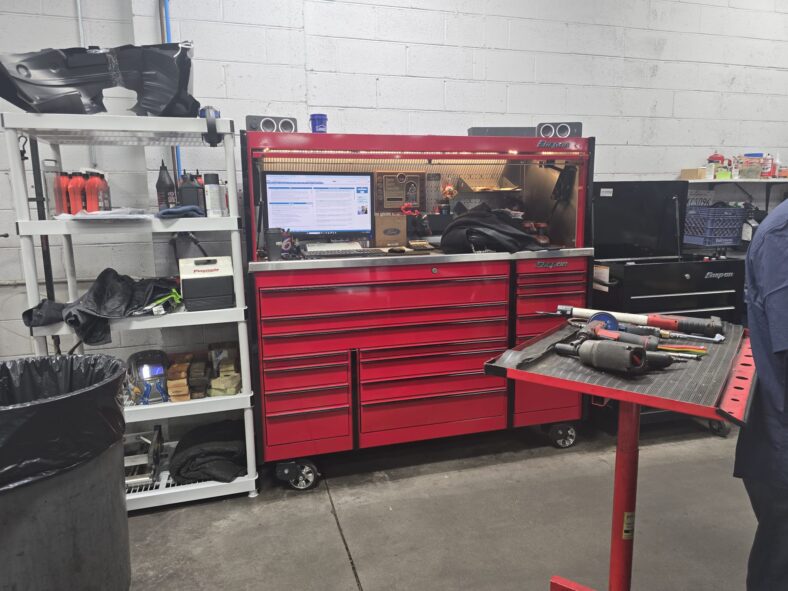
This is where the conversation got real. Russ and his colleague Jim Sambino spoke about what happens when you ignore the basics. Jim emphasized something that surprised me: your gas tank shouldn’t get below a 1/4 tank. Like, ever. My personal rule is a half tank, and here’s why: when your tank runs low, the pump starts sucking in air. Air mixed with fuel damages the fuel pump. Replacement? About $2,000 or more, depending on the automaker. For the cost of keeping your tank fuller—maybe $30 to $50 extra per week—you’re preventing a catastrophic repair.
Winter-specific maintenance is non-negotiable. That undercarriage wash I mentioned? It’s not vanity. Road salt eats through exposed metal, like frames and subframes. It affects suspension components, brake lines, the integrity of the fuel system, and the structural undercarriage of your vehicle. If you live somewhere with snowy winters, this is essential.
Tire pressure needs regular checks because cold weather causes pressure drops. Windshield washer fluid should be winter-grade. Coolant should be checked to make sure oil isn’t mixing with it and that it’s level. Inspect your hoses to make sure they’re not stiff or loose. Battery terminals should be clean because cold reduces battery efficiency, and you need all the power you can get when it’s 20 degrees, and you’re trying to start your car to get your kids to school.
My late father used to tell me, “Turn down the volume and just listen to your car. You can hear when something is wrong.” When I shared that wisdom with Russ, he agreed. Noises matter. Vibrations matter—changes in how your car drives matter. If something ever feels off, ask for an MPI with your next oil change. Many dealerships will do one regardless, but if you ask for one specifically, they might spot something you’d otherwise miss.
You Need to Know: The Technician Shortage Is Real—And It Affects You

Here’s where I want to be completely honest: there’s a crisis happening in automotive service, and it’s affecting all of us.
Jim Sambino, the service director at All American Ford of Paramus, was candid about why. There aren’t enough technicians. The automotive technician shortage is at a critical point—by 2028, the industry projects a need for 471,000 technicians nationwide. That’s roughly three open positions for every graduating technician.
Why? According to Jim and Russ, it’s generational. Nobody works on cars in their garage anymore. Nobody has that hands-on connection to engines and tools. Everyone’s on their phones. But here’s the thing: you need real passion for this work. You need to want to problem-solve, to understand systems, and to take pride in precision. And love the mechanics of how cars work.
The pay starts around $50,000 annually. After 15 years? Technicians are making close to $180,000 or more, earning up to $65 per hour flat-rate—especially if they specialize in areas like EV systems or transmissions, have all of their ASEs, and are fully certified through Ford’s technical training programs (aka a Master or Senior Technician). But getting there requires commitment. It’s a career, not a hobby.
Because of the intense manual labor and several years of committment that’s required to earn a salary like that, dealerships are struggling to recruit and keep technicians. Ford is taking this seriously, by offering a few different programs and competitive salaries.
First, They Have to Capture the Attention of Teens

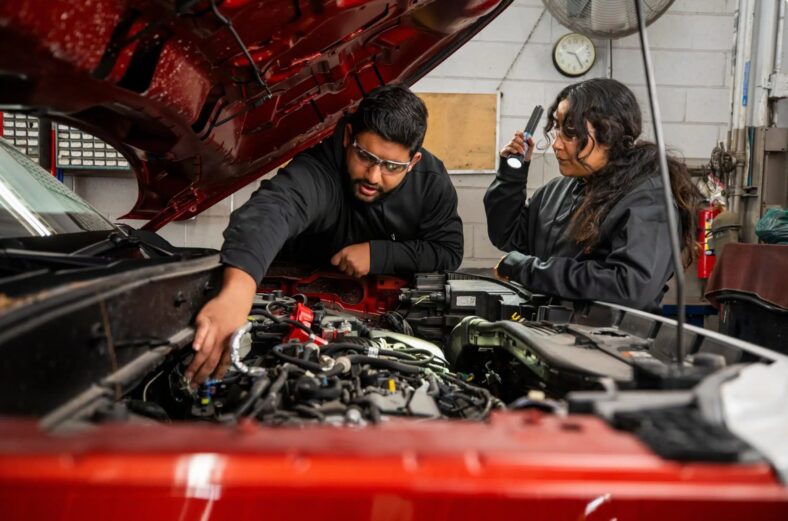
Jim and his team visit local high schools and trade schools to talk to students about career paths with Ford as a technician. Once accepted into the program, students are given a $5,000 toolbox, and they’re and provided with one-on-one training. Russ is living proof that this path works—and he loves what he does.
My husband and I joked that maybe we should get into it. Seriously, if we don’t get more people interested in becoming technicians, the service infrastructure that keeps our cars safe breaks down. You won’t be able to get your car serviced. Emergency repairs will take months. The ripple effects affect families. So, here’s some programs offered by Ford to help engage young minds.
The Ford ASSET Program is a two-year associate’s degree program offered in partnership with 41 community colleges. It’s a co-op-style program—eight weeks in the classroom, eight weeks of paid work at a Ford dealership. You earn while you learn. Scholarships of $2,500 help with tuition.
The Ford FACT Program is a 51-week accelerated training program at Universal Technical Institute across nine locations. You get into the workforce faster without sacrificing a comprehensive education. Scholarships of $4,500 are available.
ACE (Automotive Career Exploration) is a web-based training available at 1,100 high schools and community colleges to spark interest early.
And the Ford Auto Tech Scholarship Program has invested $7 million since 2023, providing 1,400 students with $5,000 scholarships to remove barriers like transportation costs, tools, and childcare.
And if you know a young person with a mechanical inclination? Tell them Ford is investing $7 million in scholarships. Tell them the pay eventually reaches six figures. Tell them it’s a career that matters.
Show Up for Your Vehicle (And Yourself)

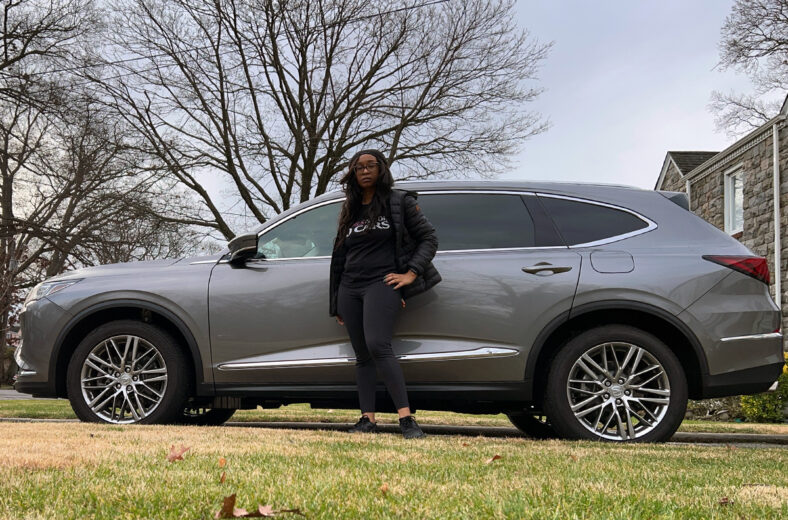
When I walked into that service bay, I was intimidated. I thought I’d feel out of place.
Instead, I felt like I was claiming something I should’ve claimed years ago—ownership over a significant piece of my family’s safety. A car isn’t just transportation. It’s the space where you take your kids to school, drive to family, navigate winter highways, and trust that everything will hold together.
Working alongside Russ for an hour taught me that understanding your car isn’t a luxury for car enthusiasts. It’s a responsibility for anyone who drives. Winter makes that even clearer. Tire pressure drops. Salt corrodes. Cold reduces battery efficiency. These aren’t hypothetical problems—they’re real, they’re preventable, and they matter.
My late father used to say, “Turn down the volume and just listen to your car. You can hear when something is wrong.” I heard his wisdom echoed in Russ’s voice. The technicians doing this work aren’t just mechanics. They’re people who care about precision, safety, and keeping families moving safely through winter.
That’s worth understanding. That’s worth the time to check your tire pressure, wash your undercarriage, and listen when your car is trying to tell you something.
And if you know a young person with a mechanical inclination? Tell them Ford is investing $7 million in scholarships. Tell them the pay eventually reaches six figures. Tell them it’s a career that matters.
Because the next time you need a technician—especially in the middle of winter—you’ll be grateful one exists.

