


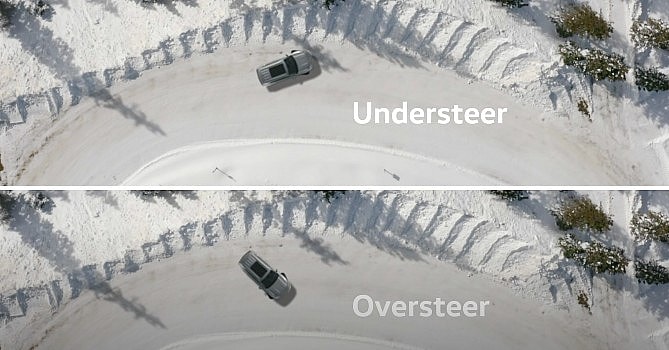
Understeer and oversteer aren’t just terms for racing.
If you’ve ever turned on a motorsport event, you’ve very likely heard the terms ‘understeer’ and ‘oversteer.’ For most folks, that’s the only place they’ll ever hear those terms—but they aren’t exclusive to racing. In fact, once you understand what these two terms mean, you can use them in your everyday life. That’s right: they’re not just for performance driving!
In this article, we’re going to break down everything you need to know about understeer and oversteer: what they are, how they’re caused, and how to maneuver your way out of any difficult situations they might cause.
Related: Take on Snow and Ice with These Tips for Driving in Winter Weather


Gif: Volkswagen
A Common Cause: Speed
Understeer and oversteer both happen when a driver takes a turn while going too fast and brakes at the wrong time. They both occur as a result of a ‘slip’ angle between the front and rear tires, which is just a fancy way of saying that your car isn’t properly lined up for a corner. The reason you hear these two terms thrown around in racing is due to the fact that the cars are traveling at higher speeds and braking more dramatically than road cars, so it’s more likely you’ll see a vehicle get a little out of control. That being said, you can absolutely fall victim to understeer or oversteer if your road car—especially if the road is icy, wet from rain, dirty, or made of gravel.
The key difference between the two concepts is as follows:
- When you understeer, the front wheels start to plow straight ahead, even if you’re turning the wheel. It’s more common in front-wheel drive vehicles.
- When you oversteer, the rear end of the car fishtails out behind you. It’s more common in rear-wheel drive vehicles.
The speed problem can show up in a lot of different places in both of these concepts, such as:
- If you’re driving too fast into the corner
- If you brake too late
- If you brake too early
- If you accelerate too soon
I know it sounds a little bit like a “damned if you do, damned if you don’t” scenario, but don’t worry! We’ll help you how to avoid both understeer and oversteer altogether and provide some tips for maneuvering your way out of a sticky situation.
If you’re more of a visual learner, then check out the video from Car Throttle embedded below:

Understeer Explained
Understeer is generally considered to be easier to correct for the average driver, so many new cars are designed to understeer. In basic terms, the car basically turns less than the driver is telling it to. The wheels refuse to turn as sharply as the direction in which the wheels are pointed. It’s like making a really wide angle.
Causes of understeer:
- Entering a corner too fast
- Too light of steering
- Braking into a corner
- Tire wear and pressure
- Low traction
To correct understeer, you can do the following:
- Reduce throttle. The car should begin to follow your steering input.
- Reduce the steering angle (which may seem counterintuitive). Basically, this means that you turn your steering wheel less, which can tighten up the angle of your front tires. It sounds weird, but by reducing your steering angle, you reduce the amount of friction being induced on the tires, which can make them more receptive to your movements.
- Try gentle braking. Very gentle braking. With just a little pressure on the brake pedal, you should be able to tighten up the angle of your car—but I recommend practicing this one before using it on the road or track, since it can be hard to know what’s too much.
Related: What on Earth Is Stellantis? Your Guide to the Wild World of Automotive Brands and the Corporations That Own Them
Oversteer Explained
If you’ve ever been in a situation where the rear end of your car starts to slip out of your control, you know how scary that situation can be. In it, the car turns way more than the driver is asking it to—which generally results in the rear tires “spinning out.”
Causes of oversteer:
- Entering the corner too fast
- Accelerating into the corner too early or too aggressively
- Braking into the corner or braking hard mid-corner
- Lifting off the throttle too dramatically mid-corner
- Weight transfer and weight distribution
- Tire wear and pressure
- Low traction
To correct oversteer, you can try the following:
- Reduce throttle—gently. The car should reorient itself. But you don’t want to hit the brakes or lift off too quickly, because that can send you into a more dramatic spin.
- Countersteering, or opposite lock. Basically, this means turning your wheels in the opposite direction. You want to point your tires where you want them to go—but this takes practice, since you have to quickly correct both the oversteer and then the countersteer when you’re back on track.
Related: 6 Safe Driving Tips to Model and Teach Your Teens

Do I Need to Worry About Setup?
Because understeer and oversteer are typically associated with racing, if you try to search for more information, you’ll likely come across websites telling you to replace parts of your car, or worry about things called downforce, or invest in different tires. These are generally recommended to maximize performance on the race track. In your road car, you don’t need to worry about all that.
Seriously. You’ll be fine. Just keep up with basic maintenance—changing oil, checking tire wear and pressure, etc.—and be wary of any dramatic weight changes you may be experiencing—like hauling six adults instead of your two kids. Drive with care. You’ll be okay.
It’s All About Practice
It can be tough to wrap your head around the concepts of understeer and oversteer unless you’ve experienced them firsthand—which isn’t something I recommend doing on public roads. But a great way to see what they feel like in practice is to find an empty parking lot or otherwise wide, clear space and try it out yourself—especially if it’s icy or if you have an open, gravel- or dirt-covered patch of land.
- Start by laying out a course for yourself. You don’t have to get out the chalk or anything, but take a moment to visualize a route you want to take. A great tip for beginners is to run an elongated oval, where you give yourself two long, straight spaces to get up to speed followed by a turn. It can be helpful to mark your turn in some way, either with a natural landmark, a cone, a bucket, or something like a light pole.
- Now, just try running that course and play around with different speeds. Go a little faster on one trip, then change the spot where you brake on the next. If you feel your car start to lose control, try to identify what’s happening—understeer or oversteer—and then correct it using the tips we’ve outlined above.
- Rinse and repeat until you feel more comfortable with your ability to correct your car’s more unpredictable movements
Alternatively, try to find some beginner’s performance driving classes near you. If you live near a race track, there’s a very good chance there’s at least one group that will provide you car handling instruction on these fronts. Certain courses let you drive your own car and will provide you with an instructor to ride along with you and help you understand where you’re going wrong. This is a great way to really grasp the concepts at hand and do so in an environment you know to be safe and controlled.
Related: We Went to Skip Barber Racing School and Learned How to Prevent a Crash


An empty parking lot with bright lines is always a great place to get some driving practice. Photo: Krzystof Kotkowicz on Unsplash
If You Can’t Correct It…
Sometimes, it can be impossible to correct your car when the steering doesn’t handle the way you’d like it to. In that case, follow these simple tips to minimize impact:
- Do not brake or dramatically increase speed
- Gradually take your foot off the accelerator to slowly reduce your speed
- When you’ve decreased speed, slowly pump the brake pedal
- Keep your eyes on the road where you want your car to go; your body will often naturally respond to get it there
- Stay calm
- If all else fails and you’re about to crash into something, aim for the softest thing you can find (i.e. a tree or wooden pole as opposed to a concrete wall or thick metal fence)
Spins and scares can happen while you’re on the road—but that’s why practice is so important. Wouldn’t you rather lose control of your rear end for the first time in a big, empty parking lot than on the road? Practice and perfect your driving skills before you need them!

