
5 Things to Keep in Mind Before Putting a Rooftop Tent on Your Car
Rooftop tents make enjoying the outdoors a lot easier, but are they easy to live with? Yes and no. Here are the pros and cons of having a rooftop tent on your car.

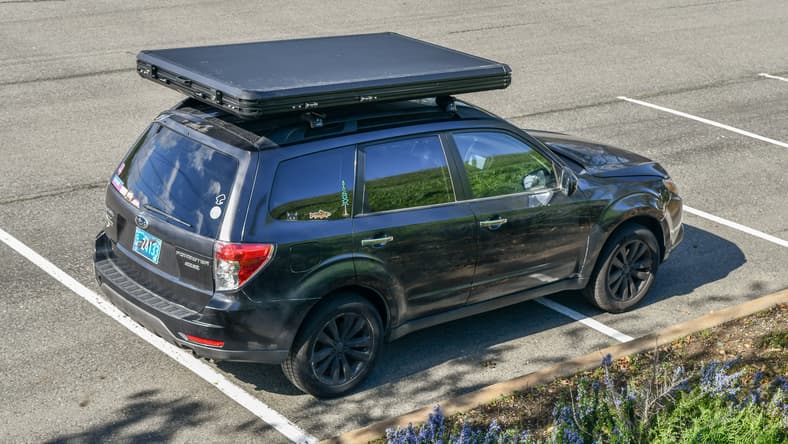
If you Googled “stereotypical Subaru Forester owner,” my picture would probably be the first thing that pops up in the search results. My 2011 is covered in Star Wars and The Office stickers, I installed a rally light bar, plastidipped the wheels black, and I drove around with a cargo basket on the roof for years—I didn’t care about the dip in MPG, I just wanted it to look cool.
Before I had kids, I took it camping and off-roading regularly, and finally, I installed a rooftop tent to up my campsite game (plus I thought it looked cool). Finally, I was a quintessential Subaru owner. All I was missing was a shelter dog to accompany me.
However, there are some things I thought through before installing one. So, to save yourself the potential headache—or finally encourage you to hit “Add to Cart,” here are five tips I have about having a rooftop tent on my Subaru full-time.
This story is 100% human-researched and written based on actual first-person knowledge, extensive experience and expertise on the subject of cars and trucks. Also, RealTruck provided me with a rooftop tent, but all opinions and impressions are my own.
1: Get Really Familiar With Your Roof and Its Capabilities

Before even discussing the typical price of a rooftop tent (spoiler: they’re usually a four-figure investment), you should always make sure your car can handle it. Many retailers will have a guide, but check your owner’s manual for two things: static and dynamic load capacities for the roof. Static load, in case you didn’t know, is how much weight your roof can withstand while the car is parked. Dynamic, on the other hand, is how many pounds your roof can tolerate while it’s in motion. For my 2011 Forester, the static load is 700 pounds, while the dynamic load is 176 pounds.
Once you figure out those two figures, it will make shopping a lot easier. Before I received the RealTruck GoTent, I checked to make sure that the tent’s weight rating was below the lowest load rating, which was the dynamic load. At 169 pounds, the tent was just under that maximum dynamic load rating. A larger and heavier one, like a tent from Thule or Yakima, may be too heavy for your car, so always triple-check that your car can support it. Thankfully, a retailer like RealTruck has built-in databases that will cross-check that data for you—but it’s always good to do your homework. Especially since some manufacturers specifically warn against rooftop tents due to how the roof was built or the materials it’s made out of.
Also, take a look at your roof setup. Do you have roof rails that can support a rooftop tent? Raised roof rails are usually better, as they can support sturdier aftermarket cross bars. Flat rails or a bare roof require a bit of aftermarket support to be able to hold a rooftop tent. If your roof rail system comes with factory cross bars (which are usually flat), check their weight rating. I bought Yakima cross bars that can handle more weight years ago, so I was good to go. But I’d never recommend putting a nearly 200-pound tent on crossbars that aren’t meant to hold that kind of weight. Because, remember, your rack has to support the tent’s weight plus your weight, as well as keep it planted while driving at highway speeds. Take weight capacities very, very seriously.
2. The Added Weight Takes a Toll on the Ride Quality—and MPG

Because my rooftop tent weighs 169 pounds, that means almost 200 pounds is sitting on the roof of my car. Which also means extra weight the car has to move. When it’s full of camping gear and my family, that extra weight on top of the car makes the engine work that much harder. Instead of 18 miles to the gallon without the tent, gear, and extra bodies, I saw about 15 mpg. It was even worse driving uphill. Plus, it produces quite a bit of wind noise. So, if you thought a cargo basket was loud… Buckle up, buttercup.
I don’t have a place to store the tent because it’s so large, and even if I did, I’d rather go bald than lift and lower it to install and uninstall it more than once. In this economy, that very noticeable dip in MPG means I only take my Subaru out for occasionally for camping. It used to be my daily driver.
The extra weight up top also means it doesn’t handle as well as it used to. The once–low center of gravity is now much higher, and I noticed it immediately in curves at higher (and even lower) speeds. It feels much tippier than it did before, and I find myself paying attention to how I brake and accelerate. Because of the extra weight, I brake sooner and follow much further behind. As my mechanic husband also pointed out, more weight also translates to faster wear on tires, brakes, and suspension components, too. So stay keen on maintenance.
3. Your Car Will Be Taller. By Quite a Bit. So, Watch Out for Low Clearance Garages

I’ve been lucky enough not to experience this, but a rooftop tent can add about 8 to 10 inches of height to your car. So, if your car barely fit into your garage before, or a public parking garage with a low ceiling, it certainly won’t if you put a rooftop tent on top. It’s worth pulling out the measuring tape and measuring the full height of the car with the roof tent installed so you don’t have an unexpected surprise pulling into the garage at the mall.
Remember when I talked about it being noisy? The added height means more air resistance, which is the main culprit behind the added interior noise and reduced fuel economy. So, not only does it decrease your car’s aerodynamics, which cuts your fuel economy, it makes it noisier, too. I solved this pretty quickly by turning up my stereo’s volume, though.
4. Installation Isn’t Hard… As Long As You Have Help to Lift It
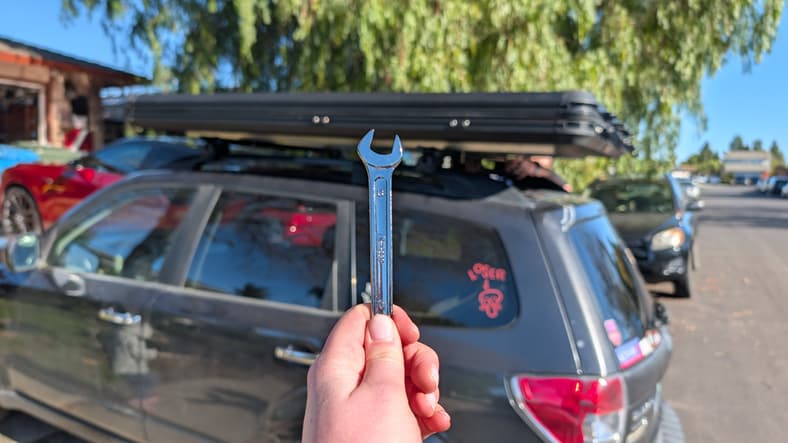
Any quality rooftop tent will be heavy, and unless you have a lift to position the tent on top of your car or you’re a champion body builder, lifting almost 200 pounds over your head and onto your roof without causing any body damage, cracking a window, or dropping it should be an Olympic sport. To install it, I had to help both my husband (who lifts 65-lb tires in each hand as a “fun” exercise) and my father-in-law, and we all struggled to keep it steady. Thankfully, lifting it up and onto my Subaru was the hardest part. Using the hardware to secure it to my roof rail and cross bar system was easy. My husband and I had it properly installed within about 45 minutes.
One thing to note, though, is that unlike other more expensive tents (mine still costs about $2,100), the GoTent didn’t come with any security measures once it was installed. The only thing that held the rooftop tent to the top of my car was a set of 8 standard 13 mm nuts. That’s it. It didn’t come with a lock, and I didn’t find a lock on the RealTruck website. Since my husband and I live in a neighborhood where things can easily, uh, disappear, I ended up spending another $80 on locking nuts that required a special socket to loosen or tighten to keep people from stealing my tent. Before that, all someone would have needed to steal with was a 13 mm wrench or an electric ratchet.
5. Storage, Even With a Garage, Can be Tricky
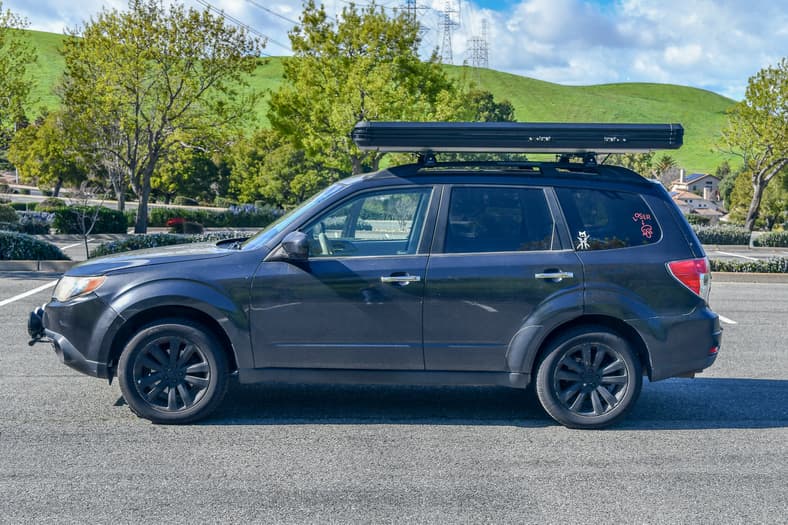
Because it required so much muscle to put on top of my car, I can’t imagine taking it off and putting it on over and over again. Once we all lifted it and set it down on the crossbars, my husband and I looked at each other and telepathically agreed: once it’s on, it’s staying on. I ain’t doing that again. Even if we did have space in the garage for it. If you camp every weekend or multiple times a month, this won’t be an issue for you. But if you only camp a few times a year, you’ll have to decide whether or not it’s worth it to leave it on top of your car.
Especially when you consider that extended time outdoors can weaken weather stripping or seals, fade and crack protective materials (especially tents with soft and loose vinyl covers). Mine has a tough outer shell, so I don’t have to worry about cracking or fading, but it does have thick weather stripping to keep moisture out—and regular sun exposure and heat can quickly cause it to become brittle and crack.
Camping is So Easy, Those Drawbacks Feel Pretty Minor

I spent my entire childhood, teen years, and early adulthood camping in a ground tent. For years, my younger sister and I shared my grandpa’s canvas military-style tent. I loved it, but setting up the footprint, picking a flat, level spot with good soil for stakes, and actually pitching the tent was… annoying. So, when rooftop tents were becoming a lot more mainstream, I felt myself get googly-eyed, drooling over pictures of Yakima tents, thinking, “Holy cow… I can just open it up, and it’s good to go?” It felt like it was too good to be true.
And there is something to be said about the ease of use. The GoTent is easy to open up and use. You just unlatch it and pop it up. It comes with a telescoping ladder and metal poles to keep the awnings open that I just keep inside the tent, so after I pop it up (which is easy because it has pistons), I keep one of the side doors open, grab the ladder, and climb in. The terms “footprint,” “stakes,” and “pitching” felt like terms I used to use from a long-lost language. I felt safer off the ground from animals and bugs, especially when I pulled the ladder into the tent and hung it up in a net above the sleeping area, and because it’s secured onto my car, it didn’t sway or move a ton with the wind.
If I did get caught in the rain, the tent material is easy to remove with dedicated zippers, so I could wash it and treat it with waterproofing spray if I wanted to, without too much elbow grease. It came with a little light you can charge with a USB cord, too, so if you woke up in the middle of the night answering the call of nature, you wouldn’t be doing it blind. I can still very much enjoy the great outdoors, but with 80% less stress. No struggling to find a spot for the tent. Simply back pull in, unlock, pop up, and you’re done. I’ll never use a ground tent again. And if you pull the trigger and buy yourself one, it comes with a few caveats, but the benefits absolutely outweigh the cons. Especially if you camp regularly.

More About:Car Culture