


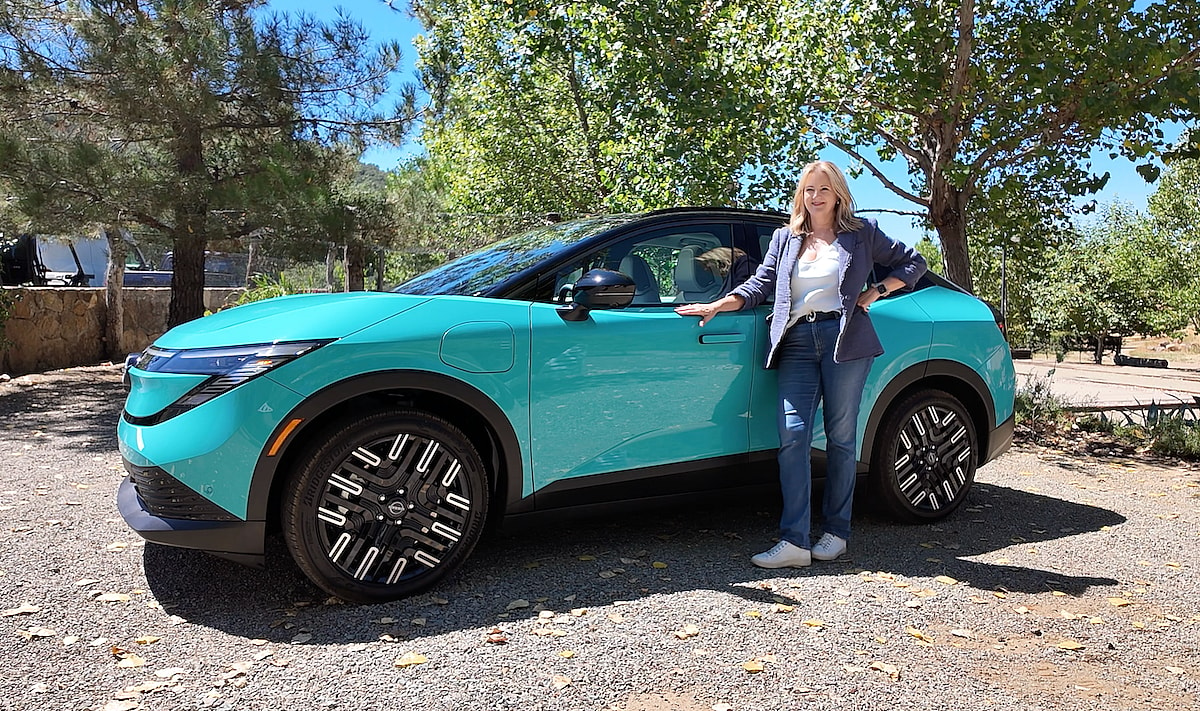
If you looked at or test drove the Nissan Ariya and are still thinking about its gorgeous open-style interior, elegant appointments and fun-to-drive energy, you’re not wrong. It’s the most beautiful car Nissan has ever built. I can’t stop thinking about it either.
Surely wandering over to the less pricey Nissan Leaf and looking around will be a disappointment. How could it ever compare?
This story is 100% human-researched and written based on actual first-person knowledge, extensive experience, and expertise on the subject of cars and trucks. Additionally, I was Nissan’s guest for this test drive but all opinions are my own.
Yes, You Should Look; This Is Not Your Grandma’s Nissan Leaf

For the last 15 years (yes! 15!) the Nissan Leaf has been the early bird, the test case and the R&D lab all rolled into one.
For many drivers Nissan Leaf was their first EV and for many, it was the introduction to low-cost, low maintenance driving. It’s how we learned about charging, efficiency and the fun of EV driving. With time and tinkering, Nissan learned a lot, too. The 2026 Nissan Leaf, priced from just under $30,000 for the step-up-from-entry model (the entry level model has yet to be released) represents a price decrease over prior models and will hit the market with a new look, new technology and features that will make you feel more pampered than prudent.
Read: I Took a Solo Road Trip in the Mustang Mach-E Using Public EV Chargers. This is How It Went
Does It Look “Electric?”

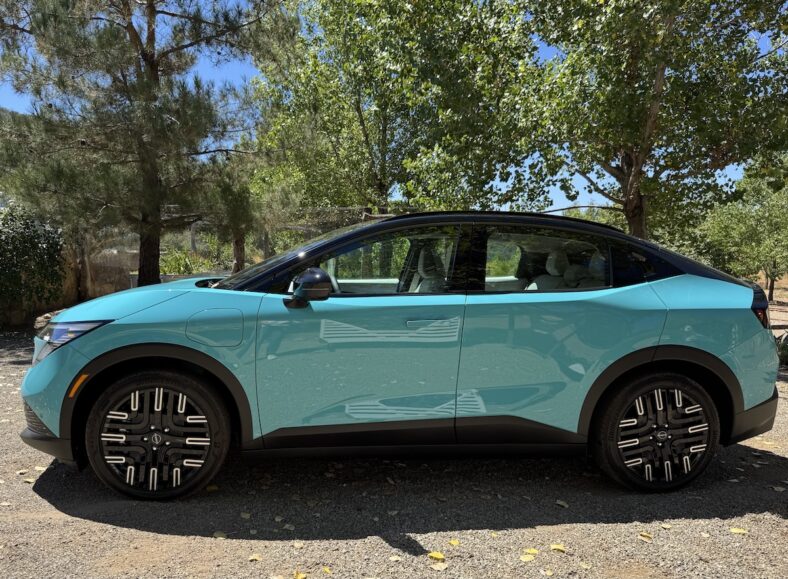
Gone is the design that screams “electric!!!” In its place is a design that intones style and intelligence. Inside, the Leaf is inflected with graceful lines, elevated technology and clever features that you might be surprised to find in a budget-friendly EV.
In all, Nissan has shaken off the “it’s an EV” identifiers and simply built a beautiful car that is electric, affordable and that will make you feel good.
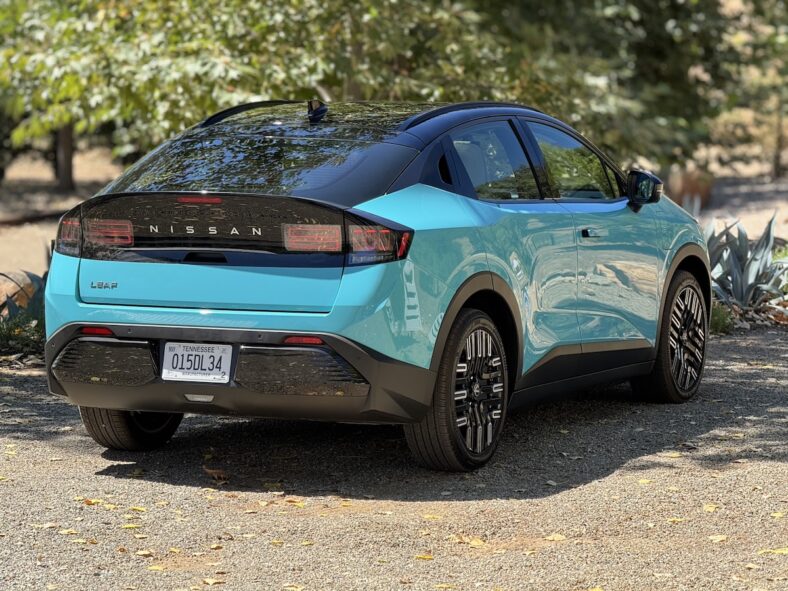
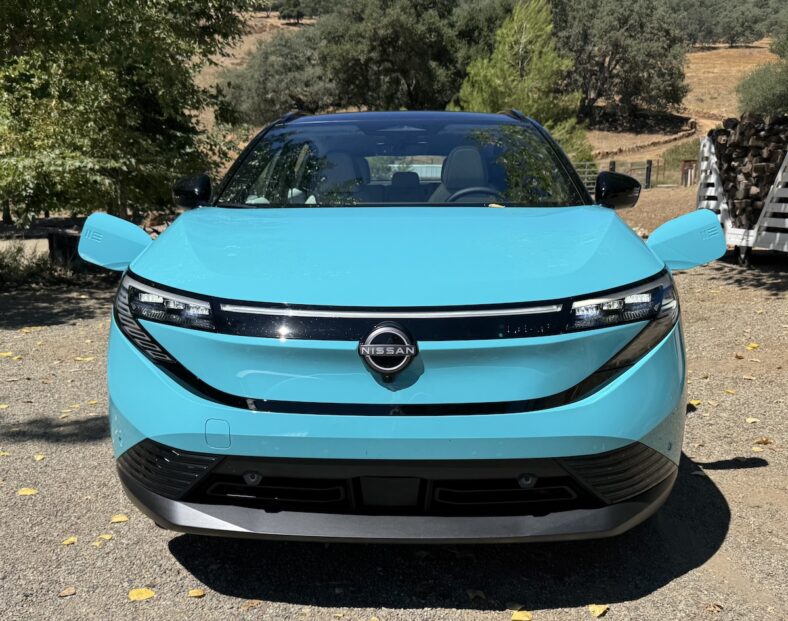
What you’ll find is a coupe-style hatchback with a pert rear liftgate, flush front door handles, iconic new tail lights and a sleek sculpted front end that veers away from the “V” grille of past Nissans and toward a wider front face framed by LED headlights and a lighted Nissan logo (on the top of the line Platinum+ model). One of my favorite details on our test model was the wheel design: A riff on a basket-weave pattern (that you’ll find on the Rolls-Royce Cullinan Black Badge edition), these wheels add a digital look rather than the spoke-style design that has dominated wheels lately. The look is so fresh.
Read: I Leased a Chevy Equinox EV After Reviewing It. This is How It’s Going 8 Months Later.
The 2026 Nissan Leaf Stats: Range, Power and Charging
In upgrading the 2026 Nissan Leaf, the company started with a new battery, a 75 kWh lithium ion battery (the entry S model will feature a 52 kWh battery with lower range and power) that can generate 214 HP and drive up to 303 miles on a single charge. The 2026 model improves range, which topped out at about 212 miles in the outgoing model and maintains a single-motor rear wheel drive powertrain; all wheel drive is not an option on the Nissan Leaf.
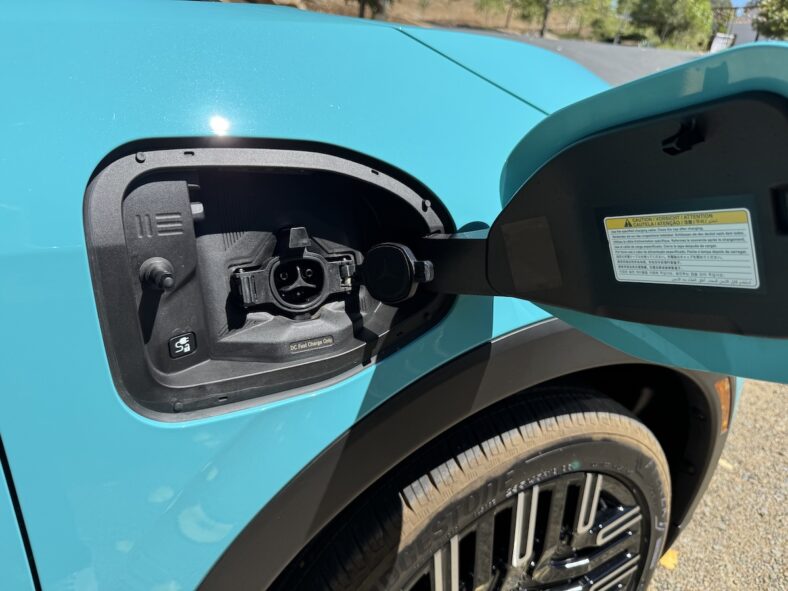
Also new for 2026 is the addition of a Tesla-style NACS charge port that allows for DC fast charging. For level 2, which is the best option for home charging, the Leaf is outfitted with a traditional J1772 charger, the old-school charge port (this port can accommodate level 1 charging too, which is via a standard 110V household outlet).
Read: 2024 Hyundai Kona Electric First Drive: Better than the Gas Model?
Two Charging Ports With Two Purposes

There are two charge ports, each with its own purpose. In addition, the Nissan Leaf supports plug-and-charge, meaning once you’ve set up your MyNissan phone app and connected a credit card, just plug in at a public charge station and charging will start right away. Here’s what else you need to know about the charge port setup:
- The NACS (Tesla-style) port can only be used for DC fast charging at a public charger, such as a Tesla Supercharger station
- Unlike other cars with a NACS charge port, the Leaf’s NACS port cannot be used for lower-power level 2 charging; if you attempt to charge it that way you’ll get a warning and a red light
- DC fast chargers deliver between 50 and 350 kWh
- The J1772 port is only for level 2 charging, the 240V outlet that is similar to what a clothes dryer requires; it can be used at home or at public charge stations
- Level 2 chargers deliver up to about 50 kWh output
- Nissan will provide both adapters: A J1772 for DC fast charging and a NACS for level 2 charging
- The J1772 level 2 charge port is on the driver’s side and the NACS charge port is on the passenger’s side
- Nissan placed these ports just behind the wheel wells to maximize access for both Tesla Superchargers and home charge stations.
Is the Nissan Leaf a “Baby Ariya?” In Many Ways, Yes
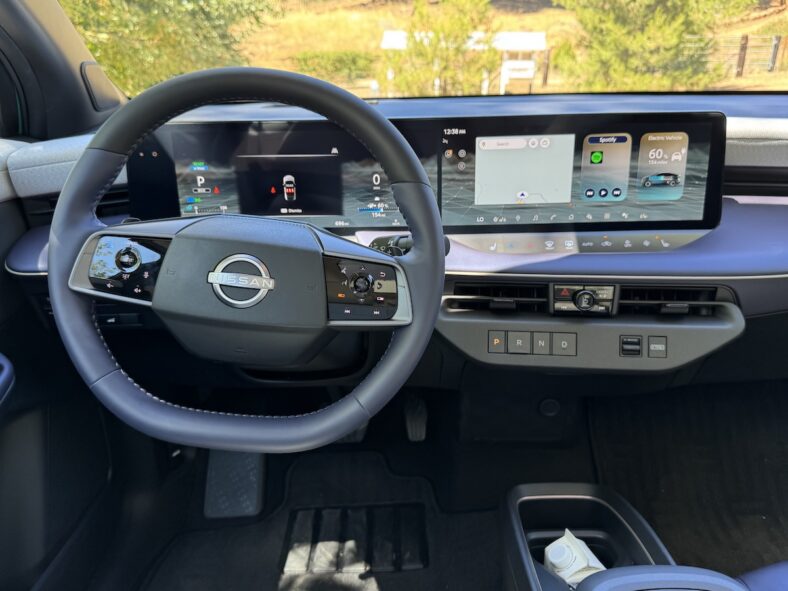
Hopping into the Nissan Leaf you’ll be surprised and delighted; I really was. But it wasn’t just the Ariya-inflected open cabin and modern design that struck me; it was all the new details that it takes from other redesigned Nissan models, all while adding its own spin.
It starts with the large 30” screen divided into two: a 14.3” multimedia screen and a 14.3” driver display (the entry level S model will have 12.3” screens, which honestly should not be much of a downgrade). The screens are nearly seamless and even share connecting graphics that span the entire 30” length of glass. This is something you’ll see on the new Armada and Murano.
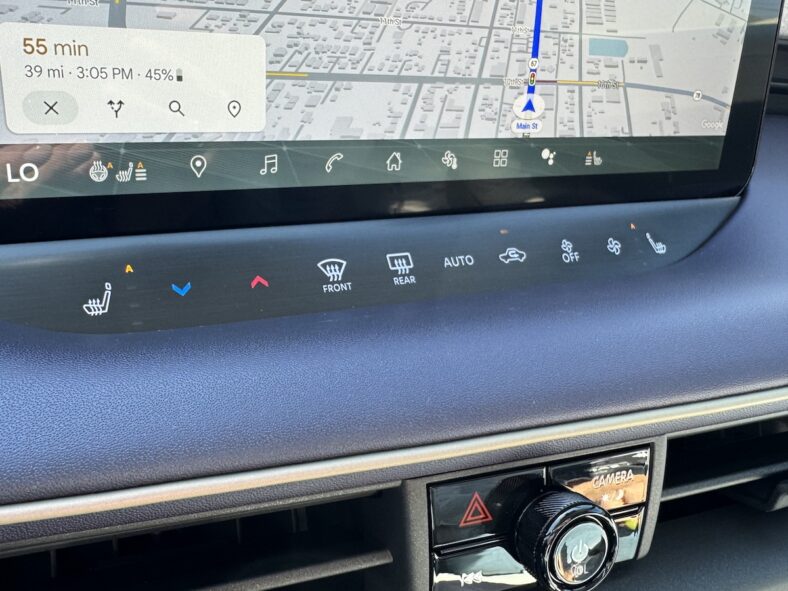
The effect is a modern look with a fast digital function. The multimedia system features scrollable screens that display a variety of functions; a fixed toolbar sits at the bottom of the screen so you can quickly access navigation, phone and more. Below the screen is a flat haptic panel for climate controls, similar to what is found in the Ariya. This panel gives you quick access to air conditioning, fan and cleaner look than dials and buttons. And, in the top two trims you’ll find Google Built-in with maps, Google account integration and “Hey Google” voice activated assistance.
Premium Materials Give The Nissan Leaf a Sophisticated Feel
The control screens are framed by a shelf-like dashboard, ours covered in a pearlescent deep violet leatherette. The color is subtle, appearing black in low light and purple in brighter sun. The violet leatherette is also found on the door panels and framing the light gray leather seats. Surrounding the top of the door panels and the top of the dash is a light gray woven fabric featuring natural slubs in gray and blue adding an organic feel to the cabin.
The cabin’s open feel is created by a center console that is low and open; it features tandem cupholders, a storage spot for a phone and USB ports. Under the arm rest is a small storage box and just in front, on our test model, is a wireless phone charger.
And then, there are the seats. Nissan has put a lot of thought into its ‘zero gravity’ technology developed to provide maximum spinal support and reduce fatigue. Adding to the appeal is the quilted and perforated dual tone leatherette.
The premium upholstery extends to the rear seats which feature a lot of legroom thanks to the under-carriage battery structure. Two forward facing seats will fit just fine (there are two full sets of LATCHes) but three may be a squeeze (though slim seats may fit, depending on the seats). Rear facing car seats should fit well, too; I measured 32″ behind the driver’s seat set for a 5’11” driver, which is a very nice amount of space for a baby seat in a compact car like this one.
The interior of the cabin looks and feels more elegant and sophisticated than you’d ever guess a budget-focused EV could deliver.
Luxuries Are This EV’s Delicious Little Secret

Premium is one thing. Luxury is completely another and this is where the Nissan Leaf really entices—at the top level, of course. Our Platinum+ model was loaded with extras that makes the thought of the $9,000 upgrade over the entry-level 75kWh model a no-brainer.
It comes equipped with a Bose sound system that features speakers in the headrests (something you’ll find in the Infiniti QX80!), heated rear seats, a dimmable sunroof that allows you to toggle through different levels of dimming, which we found did help to keep the cabin cool, and a head up display.
In our test model also featured beautiful thick plaid carpets that further quieted the cabin and added an elegant feel, akin to the feel that Rivian and Volvo achieve with home-design style carpets.
What the Nissan Leaf is Like to Drive

Behind the wheel the Nissan Leaf continues to be confident and capable. We took it through the city streets, on the highway and through the mountains outside San Diego. In all it was quiet and delightful, responsive on the accelerator and delivered plenty of power, though we did hear some wind noise on some of our drive through the mountains.
While Nissan doesn’t exactly offer one-pedal driving, drivers can slow the car through regenerative braking using the paddle shifters. The right paddle shifter allows the driver to increase regenerative braking levels (there are 4); the left paddle reduces those levels to more normal, so lifting your foot off the accelerator slows the car a little or a lot, depending on the regen level set with the paddle shifter.
Out on the highway we were used ProPilot Assist, Nissan’s adaptive cruise control, and as expected, it’s great. Nissan didn’t include ProPilot Assist 2.0 hands-free driving, however.
Customize Your Drive Style


Or, tap the e-Step button and the system is set to max regenerative braking. This is a pretty forceful setting and takes a bit of getting used to, though unlike one-pedal driving, it won’t bring you to a complete stop; you’ll still have to rely on the brakes.
In addition to regenerative braking, you’ll find drive modes (normal, eco, sport and personal) as well as steering and acceleration settings.
How Pricing Breaks Down

Think of the Nissan Leaf as the more affordable, more approachable EV and the Ariya as its pricier, more luxe-focused big sis. The Leaf is priced from about $25K to $39K and the Ariya picks up there, priced from $40K to about $55K.
Here’s how the Nissan Leaf breaks down by price, which for 2026 offers more features for less money than last year’s models:
- S Model, featuring a single motor 52 kWh battery, 174 hp, up to 196 mile range, dual charge ports, LED taillights, flush door handles, ProPilot Assist, 12.3” multimedia and driver display screens, surround view cameras, vehicle to load charge capacity via a charge port adapter, zero gravity seats finished in cloth upholstery, wireless Apple CarPlay and Android Auto, two USB ports and a smart key; price has yet to be announced but is expected to be around $26,000
- S+ upgrades the S model’s battery to 75kWh delivering 214 HP and a 303 mile range and starts at $29,990
- SV+ adds a hybrid heater system, front and rear sonar, 14.3” multimedia and driver display screens with Google Built-in and “Hey Google” voice activation, heated front seats, leatherette upholstery, 4 USB ports and a wireless phone charger and is priced from $34,230
- Platinum+ adds all the goodies on our test model: 19” wheels, lighted Nissan logo, dimmable panoramic sunroof, ambient lighting, motion activated lift gate, roof rails, rain sensing wipers, two interior household outlets (that accommodate vehicle-to-load charging), power driver’s seat, Bose premium sound, head up display, heated rear seats, heated steering wheel and memory driver’s seat and side mirrors and is priced from $38,990
- SV+ and Platinum+ models can add a battery heater package for $300 to allow better pre-conditioning for charging
- Destination and handling adds $1,495
- Range drops with higher trims due to added features and larger wheels; S+ range is 303 miles; SV+ range is 288 miles and Platinum+ Range is 259 miles
A Beautifully Reimagined Leaf For the Future of EV Driving


Nissan did some nice favors for Leaf drivers, whom the company expects will be among buyers of the 2026 model: more features, more driving range and a lower price. It delivers the same zippy drive experience and all the fun of EV driving, but with more features and more luxuries.
The as-yet-to-be-priced entry-level S model promises a very attractive entry to EV driving for a great price; in states like California where price incentives remain in place, buyers could potentially get this car for $15,000. Or, they can upgrade to the top of the line and essentially pay about what the entry level model would cost. All that is to say, Nissan did their homework and delivered its newest Leaf with all the thoughtful care it deserves, and that its buyers will love.

