
Ford’s Remapped Future: A Model T Moment Makes Way For an Affordable Ford Electric Truck
Faster to build, less expensive to buy, more fun to drive? This is the future of the Ford EV and one we're excited about.


The invention of the Ford Model T in 1908 wasn’t just about a car. It was also about the production system that allowed for an affordable, mass-produced vehicle for everyone. Something that the people working in the factories building it could actually afford. With the Model T came the assembly line, revolutionizing the way that cars were made.
This technological feat changed the world and has revolutionized nearly every industry.
But that was more than 100 years ago, and the auto industry is now at a flex point: cars are expensive, global competition is fierce, and demand continues to grow. Ford decided it was time for another Model T moment.
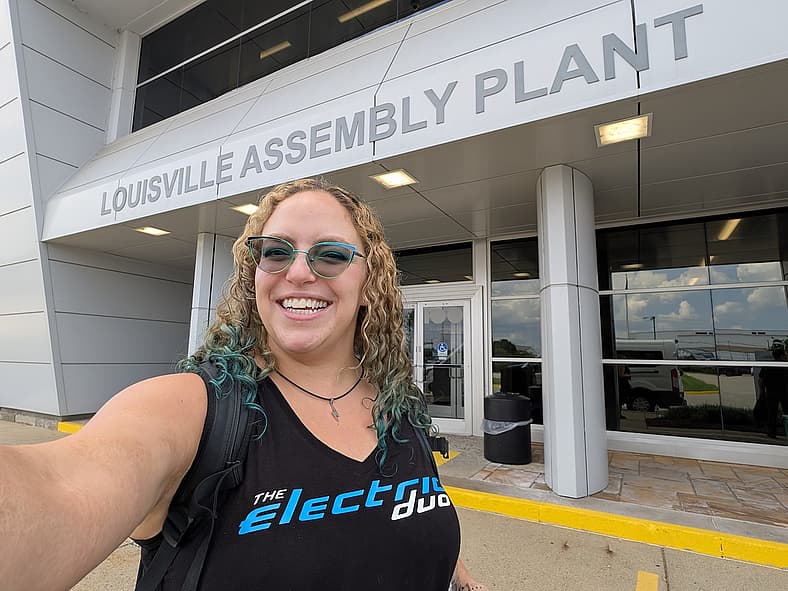
The company introduced its next era at the company’s truck assembly plant in Louisville, Kentucky. We were on hand to capture it all, including the chance to sit down with some of the people responsible for this moment and ask them all of our most pressing questions.
This story is 100% human-researched and written based on actual first-person knowledge, extensive experience, and expertise on the subject of cars and trucks.
Ford’s Model T Changed the World —the First Time
As a 122-year-old company, Ford is big, slow, and methodical. Change takes time. They do things with intention and deliberation, and these aren’t necessarily things that jive with reinvention and innovation. So, a couple of years ago, Ford built a secret team of the best of the best talent, placed them in a super secret facility in Irvine, California, then moved them to Long Beach and basically gave them carte blanche to reinvent the wheel, so to speak.
This skunkworks team, as they were called, acted with the creative zest of a startup but with the mighty backing of a legacy auto maker, and they really did reinvent everything. Last week, the Skunkworks team in Long Beach celebrated the public unveiling of their West Coast Campus. At the announcement in Louisville, Ford unveiled two things that are absolutely shaking the foundations of the car industry: the Ford Universal EV Platform and the Ford Universal EV Production System. They also shared details about their first new EV in this ecosystem and teased a portfolio to come.
Read: The Ford Maverick Added Hybrid AWD And Other Goodies
Reinventing the Production System Is the Key to the Future
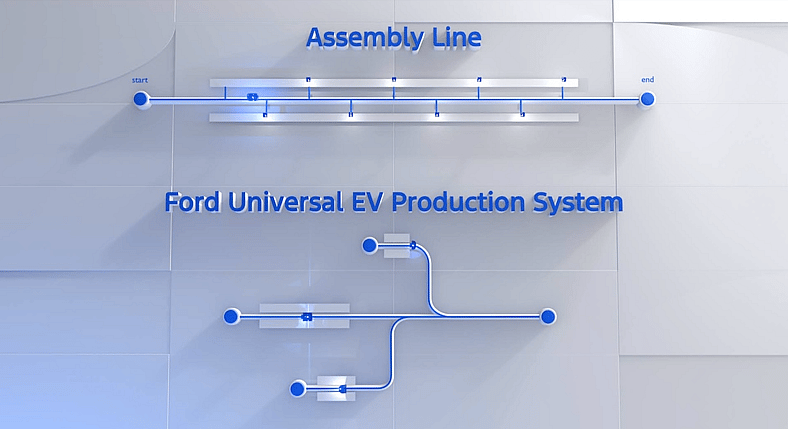
In the same way that the assembly line changed the game completely, so too will the Ford Universal EV Production System. The assembly line, a single stream of production that adds parts to a car as it passes through stations, has served so well for so long. But to make the process more efficient, effective, and less expensive, Ford’s Skunkworks team broke it down and sped it up: the production line now looks more like a tree with three concurrent branches, with the front, middle, and rear of the vehicle all being worked on independently before the vehicle comes together.
This will both simplify and speed up production significantly. The time savings will allow the next-gen electric vehicle to be produced up to 40% faster than the trucks that are currently built at the Louisville plant, which is being retooled to produce a new EV.
This Universal EV Production System will also make car building significantly easier, safer, and less-intensive for workers and serve as the framework for the mass-production process needed to build an affordable EV.
Ford is also incorporating AI in their manufacturing, but they stressed that jobs will not be lost due to AI simplification. It will just make it easier for the humans behind the machine because the new production system goes hand in hand with the Ford Universal EV Platform.
Read: Slate Auto Introduced an Affordable, Customizable Electric Pickup Truck So Cool, I Ordered One
The New Ford “Model T Moment:” Inspired By Lego?

The new platform takes the capabilities of auto production to the next level through the three-branch idea: The middle branch is where the batteries are incorporated into the frame of the vehicle between the wheels. This allows for even more room than many EVs built today. The front and rear are built on the other two branches. In Ford’s demonstrations, it appears that the system can accommodate a large SUV or a compact one, a van, or even a mid-size truck.
To accomplish this, Ford has also developed an entirely new modular system of building cars, creating a framework for the family of vehicles to come. It includes large single-piece aluminum uni-castings that will replace dozens of smaller parts. Ford says, there are 20% fewer parts in the new “Model T Moment” EV than a typical car: 25% fewer fasteners and almost a mile less wiring than they used in the Mustang Mach-E. All this amounts to less cost and faster assembly down the line.
This teaser of what Ford is planning gives us a lot to look forward to.
Read: I Leased a Chevy Equinox EV After Reviewing It. This is How It’s Going
The First In the New Ford EV Line? A Truck, Of Course!

Faster, smarter assembly is just the start, though. As Ford changed the world by creating the assembly line, Ford engineers told us that they plan to make this tech available to everyone, not just exclusive to a premium segment.
It’ll start with Ford’s first vehicle built on this platform, a mid-size truck that will debut in 2027, and with a price target of about $30,000. As Ford execs talked about the truck, they emphasized there will be no compromises. They promised a fully-featured, fully-equipped pickup truck that seats 5 adults, has more passenger space than the latest RAV4, fast charging, can power a house for 6 days, has a lockable truck bed and frunk (front trunk), and has a 0-60 faster than a Mustang EcoBoost (around 5 seconds).
Doug Field, Ford’s EV chief, said they may even eliminate trim options for this truck since they are planning a fully-stacked truck with an “amazing” in-vehicle digital experience. “We want to differentiate in things that don’t disrupt the production flow,” he said.
The description of the truck might just be Ford’s dig at Slate Auto, the blank canvas EV truck that boasts a modular upgradeable system with a heavy old-school charm, including manual crank windows, no multimedia display, and a $25,000 price tag. Compare that to a fully tricked-out mid-size truck with a well-integrated multimedia system, reverse charging power system, and passenger comforts for $30,000, and you have some serious competition in this segment.
Ford’s New EV Pickup Truck Leaves A Rosy Glow–With Those Who Saw It

We didn’t get to see anything of the actual vehicle, but we did get to see the reactions of 6 employees of the Louisville Plant and Michigan’s Blue Oval Battery Park as they viewed the truck for the first time. After the event, I chatted with Emma Venard, Vehicle Evaluation Manager of the Louisville plant, and Telicia Williams, Delivery Operator, and their excitement was evident. I also chatted with engineer and automotive YouTuber Sandy Munro, who had toured the vehicle. He said that when he saw it, the first words out of his mouth were “Well, that’s a Model T moment if I ever saw one!”
Not every detail was quite as rosy, though. Ford execs said they would use the same 400-volt charging architecture as the Mustang Mach-E and the F-150 Lightning. Many of us were hoping for 800-volt used in EVs from Hyundai, Kia, Genesis, Audi, and Porsche, and will be seen soon in VW models. That architecture allows vehicles to charge from 10-80% in about 18 minutes, whereas the Mustang Mach-E takes about 35 minutes. As someone who lives with a Mustang Mach-E and an Equinox EV that charges even slower, I feel like 35 minutes is just fine for me, but I know that many people expect more for 2027.
Ford did say, however, that their first truck would have “unprecedented aerodynamics” that will help them reduce the battery size by a third, which will be nice for interior space and efficiency.
The Future of Ford EVs: Looking Pretty … Pink?
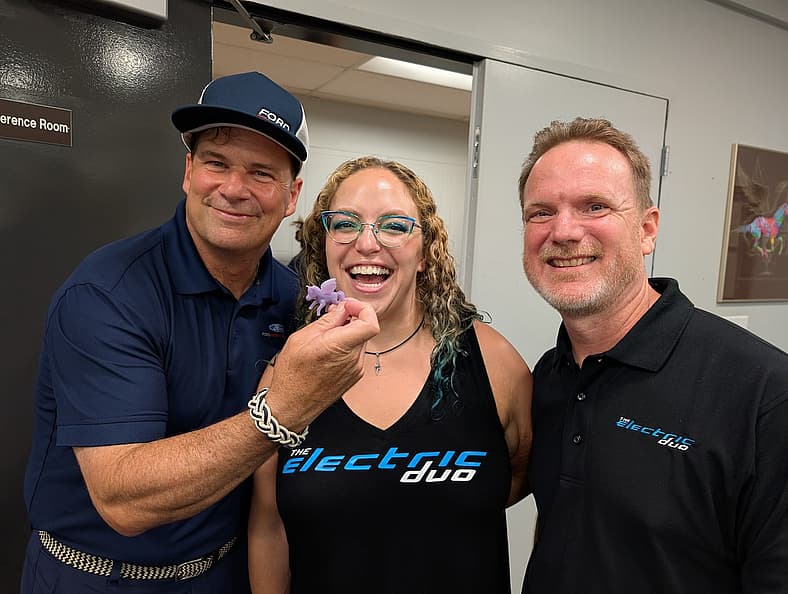
I’m a huge fan of the Ford Mustang Mach-E. I’ve owned two, and my husband and I co-founded the Mustang Mach-E Club of America. As Mach-E owners, we hope this innovation spills over into how other Ford EVs are designed and built—and priced. As much as I pressed, I couldn’t get anyone at Ford to share anything about the future of the Mach-E or F-150 Lightning. But I did get to give a second Fancy Pony, something I give to Mach-E owners, to Ford CEO Jim Farley to complement the pink one he now keeps on his desk.
Ultimately, some were disappointed that we didn’t get to see the new vehicle on our trip to the Louisville Assembly Plant. But I’m not. What Ford unveiled was a significant dedication to a radical, innovative electric future with a platform and production system that will be deployed in their existing manufacturing. Ford has the might, the plan, the roadmap, and now all it’s going to take is time—and to get it right. 2027 isn’t all that far away; it won’t be long before we start to see the results of the next “Model T.”

More About:Electric Cars