
ALSO Is the E-Bike That Convinced Me a Bike Could Work For My Life —Thanks to Rivian
Before driving out to Palo Alto to test ALSO’s first software-defined TM-B e-bike, I’d never ridden one. Now I don’t need to ride any others. And I might get one for my husband.


When the term “e-bike” started floating around, I had a bitter taste in my mouth. I pictured it being similar to my e-scooter experience while I was in college: being nearly collided with multiple times by non-helmeted students, quite literally racing to class while peering at their phones. I wouldn’t hear the electric motors until the last minute, then I’d dash out of their way, only to hear a half-assed “Sorry” escape their half-awake mouths.
When I lived in Monterey after graduation, the same thing would happen while I walked with my husband on the trails hugging the coastline. It was also a beacon of wealth, as most of the e-bikes that nearly crashed into us at 20-25 mph on a shared trail cost anywhere from $8,000 to $10,000.
So, when I was invited to Palo Alto, CA, to meet the executives behind ALSO, a company founded with Rivian’s backing and technical support, to test their new, affordable, software-defined e-bike before its launch, I was skeptical. Only a few minutes behind the handlebars of the top-shelf, $4,500 Launch edition changed the way I look at e-bikes forever. Shoot, I just might order one for my husband.
This story is 100% human-researched and written based on actual first-person knowledge, extensive experience, and expertise on the subject of cars and trucks. Additionally, I was ALSO’s guest, but all opinions are my own.
Even For a Noob, ALSO’s Bike Was Incredibly Easy to Figure Out, Thanks to New e-Bike Technology
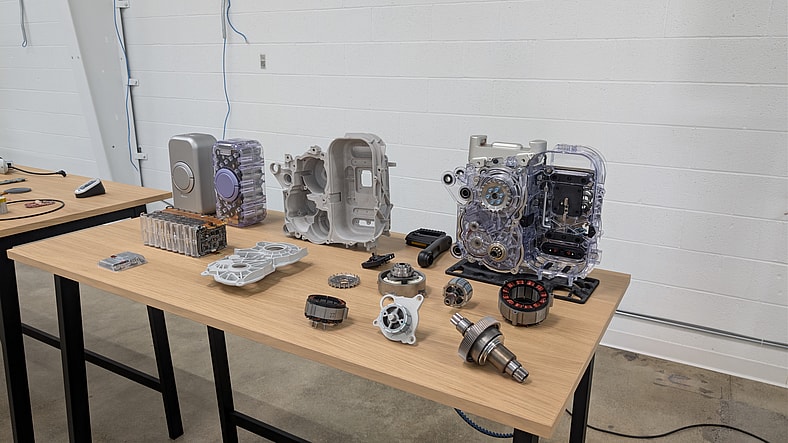
When I’d met the incredibly kind execs behind ALSO, they’d asked me if I had ever ridden an e-bike before. I shook my head shyly, and they were excited to be the first company to break me into that realm–and I was, too, because everything about the bike was intuitive and noob-friendly.
Most e-bikes, they explained, are a small electric motor slapped onto a normal chain-driven bike frame. Therefore, there aren’t any drive modes, the pedal assist is rarely adjustable, and the rider is still doing most of the work. For the money, the only benefitting is the company that convinced the person to buy it at such an elevated cost. ALSO’s bike was pedal-by-wire, so the rider’s kinetic energy is converted to usable energy for the bike’s generators for a traction motor, which can then maintain, match, or multiply that energy. When charged, depending on the pedal assist selection (going from 1 to 10, 1 being the least amount of assist and 10 being so easy you can breathe on the pedals to get it moving), it has 100 miles of range.
So, after a long day at work, you can choose between a decent workout or a leisure ride home, since it can go 25 miles with no input from the rider, at a max speed of 20 miles an hour. Though the rider can go up to 28 mph if they assist the bike at assist level 5. Like Rivian’s EVs, it also has regenerative braking, which captures up to 25% of the kinetic energy to recharge the battery. It’s the ultimate commuter bike, or if you take it with you on vacation, a great cruiser to skip traffic.
The Software Was Intuitive, and Will Technically Never be Outdated
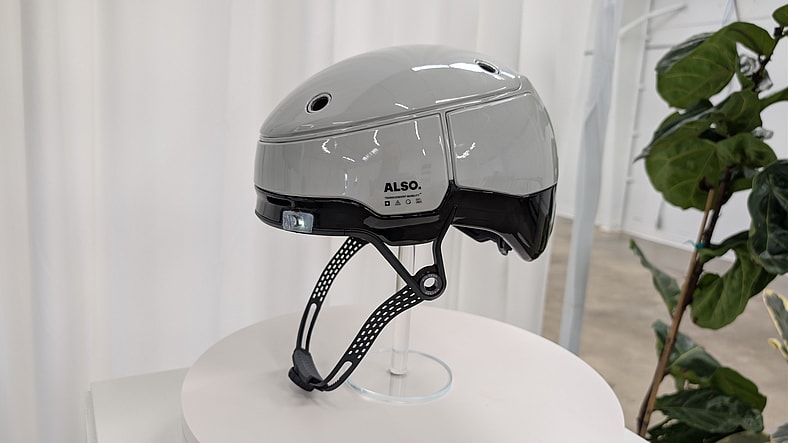
One of the other interesting things about the TM-B bike was the fact that everything–and I do mean everything–was powered by incredibly powerful software that was developed in-house (and yes, in collaboration with Rivian). It can connect to WiFi, LTE, and Bluetooth, so it’s always connected to something, making it easy for the company to update OTA, brick it if it’s stolen, it can be GPS tracked, and it can even connect to your phone to answer calls, listen to music, or follow GPS directions. No other e-bike is updatable.
The Alpha helmet, which directly connects to the bike, has headphones over the ear (complete with subwoofers–you know I had to ask about that), downward-facing microphones to capture your voice, and cancel out wind noise so you can take calls without people knowing you’re actively riding the bike. You can listen to your podcasts, too, while still being aware of your surroundings. The helmet is still in development, but I was told it would feature bright lights for drivers at night, headlights on the front, rear lights on the back that could act as turning signals, and so much more.
The center screen on the e-bike was easy to control, even while riding, and it was bright, crisp, and one of the most responsive screens I’ve messed with. It took me maybe two minutes off messing with before hopping on to figure out what the controls were, where the settings function was, and how to make any adjustments. Of course, there’s a companion app that has tutorials and resources, too.
Security For an e-Bike is Well Thought-Out and Top-Notch

Being software-defined comes with another underrated benefit: excellent security. When paired with the companion app, your phone acts as a digital key that can lock or unlock the bike depending on whether or not you’re approaching or leaving the bike. If someone walking up to it doesn’t have the key, the bike is essentially a paperweight.
The team told me that they can’t stop someone from picking it up and throwing it into the back of a truck if it isn’t chained up or locked, but in case that does happen, alerting the company will prompt them to brick it from HQ, and they can track the bike in real-time. They can give tracking data to police to track it, and then if recovered, they can unbrick it and life can return to normal.
If the bike is destroyed, the bike’s owner can mark that it wasn’t recovered, and the company can permanently brick it. And the only people who can unbrick it would be someone at ALSO. The battery is removable via a digital latch, and it can be charged with a simple USB-C connection, but it can’t be removed unless the digital key is detected. Otherwise, it would take the strength of Godzilla and King Kong to remove it.
It May Be Electric, but The Battery Will Never Die

Because I’m a parent, one thing I’m good at is chronic overthinking. So, when they mentioned that the range is up to 100 miles with the assist on a mid-level setting and 20 if you don’t assist the motor at all, the first question I asked was, “What if you’re heading home, you’re almost there, and the battery runs out because you didn’t get a chance to charge it? If there’s no physical connection between the pedals and the generator, how would someone get home?”
The execs were prepared for my answer, and they explained that if the battery got that low, it would default to a setting that would match the generator’s output to the rider’s input, so it would keep itself from ever draining completely. The rider would get home just fine. And, when they do get home, the battery would charge in just two hours. No sweat.
Being Modular Has its Benefits

Yet another benefit of being defined by powerful software is the fact that multiple people can be programmed to one bike. Chris Yu, the company’s lead, said that he and his wife share a bike by having their own programmed seats. His seat is programmed to his digital key and hers is programmed to hers, so when either one walks up to the bike with their phone nearby, they can swipe down on the bike’s main screen, click “Swap Seat,” and the seat will unlock. From there, either one can remove the other seat, place their own on the frame, and have it lock in place.
Chris’s seat had a child’s seat on it, so he could drop his son off at school (and skip the drop-off line in style). His wife uses it to ride to the farmer’s market and carry her goods home, thanks to baskets that latch onto the frame in front, in the back over the wheel, or on the sides. When his son is older, he can buy his own seat and ride it, and have their settings and preferences automatically applied with the bike detects their key.
The Price Makes Clean Mobility a Lot More Attainable for More Buyers

As I rode with Chris through a quiet residential area to experience the bike for myself (and of course, falling in love with it), I turned to him and said, “Alright, be honest with me… How expensive is this thing? Based on the suspension, the technology, the software that’s constantly updating, the ride quality, and whatnot, it has to be chilling in five-figure territory.” He smiled and told me that at the top of the line, it starts at just $4,500.
At first, I thought it was a bit much for an e-bike–but then I started doing the mental math. For instance, when my husband and I lived in the San Francisco Bay Area, he worked as a technician at an independent repair shop that didn’t require getting onto a highway. It was just seven miles away, but it would take him 45 minutes due to commuting traffic. If he had an e-bike, it might take him a little longer, but he’d automatically save on gas, monthly insurance, and registration costs, since e-bikes don’t require a specialized license to operate.
Well before a year of ownership, the bike would have paid for itself with those savings alone. If you live in and commute within a city like San Francisco, Los Angeles, Seattle, or even Houston, it would benefit commuters to invest in an e-bike instead of sitting in traffic every day. For a lot of people, an e-bike like the TM-B could be a total vehicle replacement for commuting or city-based errands.
The e-Bike Culture Changed for Me, and I May Have to Buy One for My Husband

Because the TM-B has integrated turning signals, an excellent screen, a riding dynamic that was easy to become acquainted with, and it was built by a team that was driven and very eager to constantly improve, what I thought about e-bikes changed for the better–as long as it was an ALSO bike, of course.
When I first met with Chris Yu, who previously worked with Rivian’s RJ Scaringe, he said he’d asked RJ why they don’t take the technology they have for cars and extend it to bicycles. It all made more sense. The attention to detail, thoughtfulness, design, software capabilities, and their answers to every “what if” question I had told me all that I needed to know: out of all the e-bikes out there, the ALSO bike was worth investing in.

More About:Car Culture Car Buying