


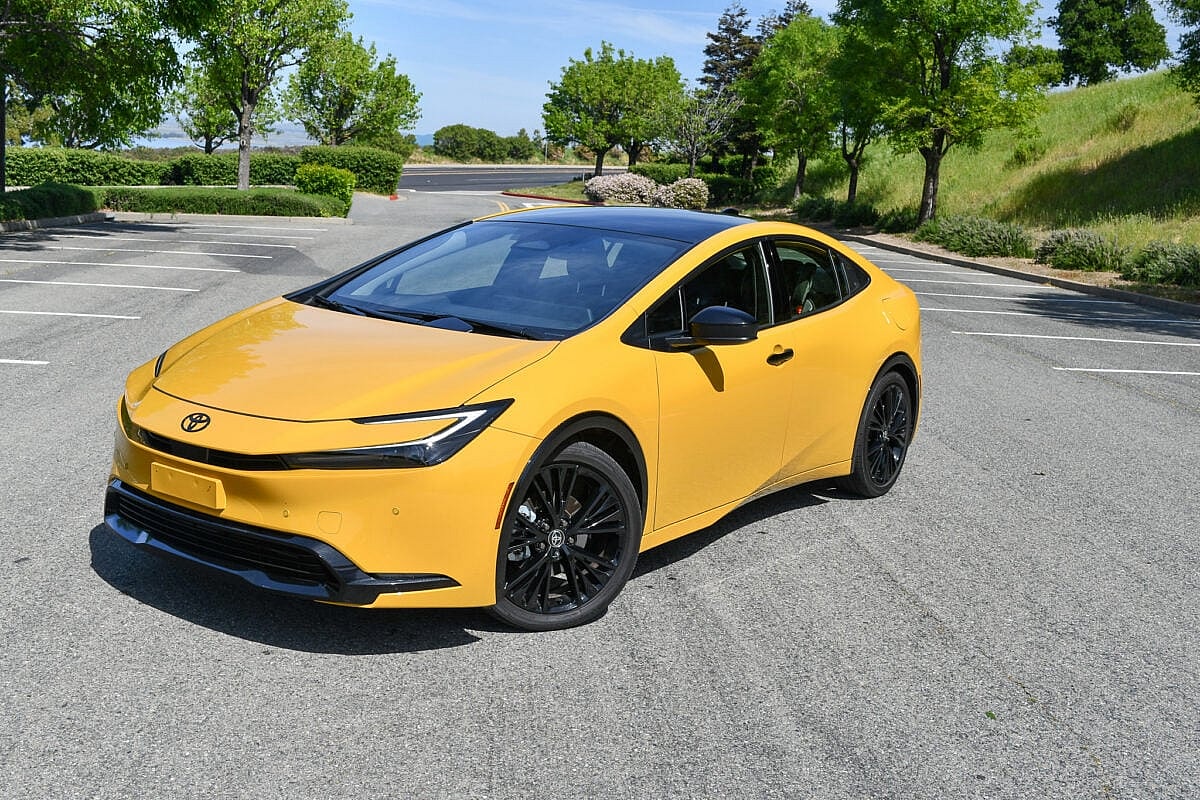
Right now, even those in *comfortable* tax brackets are feeling the squeeze of the economy if they have to buy gas. While Hybrids and EVs have shone for limiting our eliminating our trips to the gas station, right now they simply shine as gas prices climb higher and higher. In the San Francisco Bay Area, where I live, it’s not uncommon to see prices float above $6 per gallon.
As the owner of an older Subaru, getting around 17 mpg really stings. Fueling up costs me about $80 per tank, and I only have to fill up once every two weeks. So, when it was my turn to review a 2026 Toyota Prius XSE Nightshade PHEV, I was excited. Not because it was yellow, not because it had black wheels or a fixed glass roof, or the optional 12.3-inch touchscreen. I was excited because it’s rated to achieve 48 mpg. That’s almost triple the mileage I get in my Subaru.
The PHEV can go about 44 miles in EV mode, too, giving me that far of a head start before I have to start burning any gas. So, grocery store runs, school drop-offs, or coffee drive-thru stops could be done without turning the engine over. Before even considering the updated looks, that’s what mattered most: the mileage.
Finally, I understand why Toyota hybrids—the Prius in particular—are so darn popular out here.
This story is 100% human-researched and written based on actual first-person knowledge, extensive experience and expertise on the subject of cars and trucks.
First, Let’s Do Some Number Crunching to Show How Far Ahead the Toyota Prius Really Is


The Bay Area is a place where everything, from the redwoods to a simple grocery run, feels far away, expensive, or both. Whether you are commuting from the East Bay or heading to San Jose, traffic isn’t just a nuisance; it’s a regional personality trait. Seriously. We plan our entire days around the traffic we’re bound to hit. In this high-pressure environment, the 2026 Toyota Prius has become an unsung hero, either as a PHEV or standard hybrid. It isn’t just a car; it’s a survival tool for those paying the highest gas prices in the country.
With gas routinely causing emotional damage at the pump, the Prius changes your relationship with the road. Here’s how:
- Efficiency: The PHEV offers 44 miles of electric range and 46 mpg when in hybrid (HEV) mode, allowing many to finish their daily routines without using a single drop of gas. The standard, FWD hybrid gets up to 57 mpg, for those who can’t plug in and charge overnight.
- Attainability: While the average new car price sits between $45,000 and $53,500, the Prius remains shockingly attainable. My tested XSE model came in at $41,350 with add-ons, while the standard hybrid starts at just $28,550.
- It’ll Commute For You: Toyota’s advanced highway driving assist feature, which is an updated advanced cruise control, will literally commute for you. Including the stopping and braking. All you have to worry about is lane changes and steering. It even slows down for curves, and it’s one of the most accurate and responsive systems I’ve tested.
- Accessibility: It’s one of the few vehicles that still feels within reach for the middle class because of the price range—teachers, nurses, and families trying to make the local math work. The most expensive Toyota Prius, the XSE Platinum PHEV, starts at $40,150. Can’t beat it.
During my time with it, I averaged about 45 mpg, which proves the EPA estimate right. When I was on the highway, I averaged about 48 mpg as long as I kept speeds under 75 mph. I was in love. By the time the fleet company had to pick it up, I’d driven almost 200 miles, I wasn’t even close to half a tank. Do with that information what you will.
The Updated Styling Makes it Fit In With the Palm Trees and Rolling Hills


I grew up hating the door-stop-looking Toyota Prius, because its drivers were well-known for camping in the left lane and slowing us down on the “secluded” mountain roads. While the 2026 refresh definitely maintained the wedge shape (for aerodynamics, of course), it definitely feels more “California” with the company’s hammerhead headlights, blacked-out accents as part of the Nightshade package, and fun Karashi (Japanese for Mustard) yellow color. The latest redesign gives the Toyota Prius a sleek, modern look that fits right in with the Teslas and Rivians on the highway.
Finally, it’s not embarassing to say you drive a Toyota Prius. Because, now, the youngins you share an office with won’t assume the Prius name with staring at Coexist, Bernie Sanders, or Equality stickers while going 55 in the express lane. They’ll associate it with a fun, energetic, and stylish design. Maybe, just maybe, they would even pictures themselves in one—because, you know, they would be able to afford one.
The Interior Feels Nice

Admittedly, I’m an interior snob. The way an interior looks and feels would absolutely keep me from buying one, no matter how smart a car is to buy. I was not a fan of the previous generation’s interior. Not by a long shot. So, I wasn’t expecting much from the new Toyota Prius, especially because of the price. But I was shocked by how much I liked it.
Of course, it’s not perfect. There’s still a lot of black plastic, and I’m not big on the driver’s display because its placement made it hard to find the perfect place for the steering wheel without it obstructing the information on it to some extent. And the dashboard feels like it’s about a mile away from the engine’s firewall. I also didn’t care too much for the very low seating position, as it made it harder to see out of then Toyota’s other hybrids.
But Toyota addressed all those issues with an array of cameras and sensors to help bridge the gap, and once I spent a couple days in it, I got used to it very quickly. My Toyota Prius tester came with the larger 12.3 inch multimedia screen (costing $619) instead of the 10-inch one, and I feel like that’s a non-negotiable upgrade. It makes the Prius feel so, so much more expensive. In California, it helps it lean into the tech-forward and chic lifestyle we’re all living. No one would feel like buying a Prius is a compromise.
If Needed, the Prius Can Fit the Family—But Barely

My daughters are turning 4 and 3, and now that Mommy’s been through her fair share of press loans for review, they’ve had a lot of fun expressing their opinions. My oldest daughter told me the color made her think of a baby school bus, so she adored the outside. But she was not a fan of the inside. She didn’t like that the windows were tall and it was hard to see out of, but she adored the fixed glass sunroof (a $1,000 upgrade—totally worth it). There weren’t any AC vents for rear passengers, either. So my daughters definitely felt the heat back there.
However, parents beware: the trunk is extremely small. It has the cubic footage, but what it’s lacking is vertical space. The PHEV cable takes up a good chunk of that space if you can’t keep it in a garage, because there’s no underfloor storage for it. It can fit the groceries, but I wouldn’t trust it for a Costco haul or a family road trip. You’d need a bigger car for that.
And that’s why I say it fits into the Bay Area’s typical two-car formulas. Most families have a dedicated commuter—like a Toyota Prius—that the kids don’t ride in. It’s strictly for getting the commuting parent to and from work. The other car in the driveway is typically a family-oriented SUV. If you had to fit the kids in a Prius, you could. But I wouldn’t recommend one as a full-time family hauler.
The Toyota Prius is Predicitable, And That’s Its Strongest Point

The Toyota Prius offers something rare in a region defined by relentless traffic: predictability. It makes the daily, annoying struggles of California life a little easier to live with, without requiring a massive financial sacrifice. And with how much you’re saving at the pumps, it pays for itself within a few years. And it won’t ever stop, since gas will always be pricier in the Golden State.
I am fortunate enough to work remotely, but if I ever find myself back in a daily commute, I would 100% be leasing one. You just can’t beat the price, the updated looks, and the miles per gallon.

