
The 2026 Polestar 4 Follows Sage Advice: Perfect Your Look By Removing One Thing
Coco Chanel said it, but Polestar proves it in the Polestar 4, a refined and perfectly toned luxury EV.

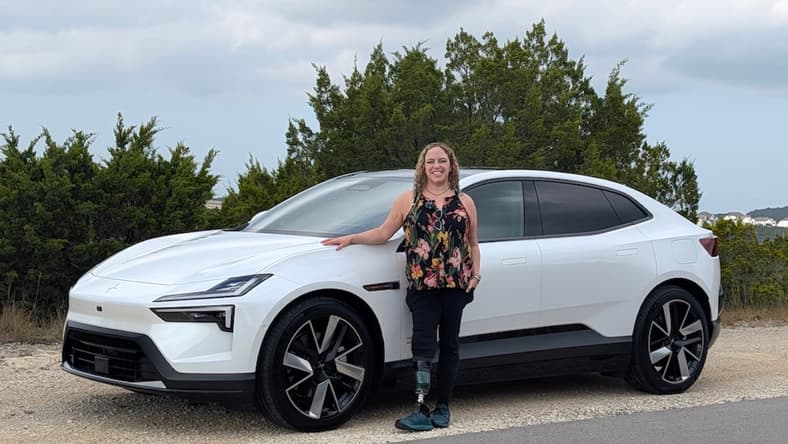
Do you know that friend who always dresses impeccably but never ostentatiously? You can tell her gorgeous clothing is top quality and tailor-made. As you give her a hug, her perfume, a complex niche scent, whispers of sophistication. She’s always supremely put together in an unpretentious, quiet way. And there is no question that it’s all 100% deliberate. Much like the Polestar 4.
But that’s Polestar’s signature. The brand’s high-performance, high-quality vehicles don’t scream their benefits at you. Their cars are refined, functional and beautiful. The newest to be added to the North American lineup is the Polestar 4, a sleek electric coupe is filled with delightful surprises and one thing that’s missing, making us ask: do we really need it?
This story is 100% human-researched and written based on actual first-person knowledge, extensive experience, and expertise on the subject of cars and trucks. Additionally, I was Polestar’s guest for this test drive but all opinions are my own.
The Polestar 4, a Sleek Sedan That Holds a Lot of Surprises
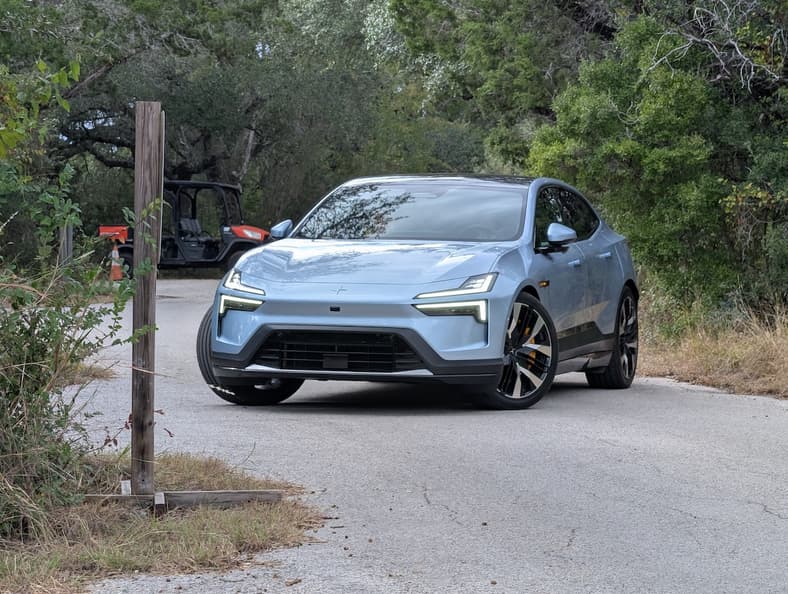
Meet the Polestar 4, priced from $56,400, a sleek SUV coupe with the stature of a sedan and the interior room of a spacious 5 seater. Though it has been available in Europe for a little while, it has finally come to America.
And thankfully; it carries all the perfectly tailored tech, stylish design, and a sporty drive drive experience that we’ve come to expect from the performance brand. To celebrate its arrival, I was treated to a rollicking romp around the outskirts of Austin, Texas, where I was able to put this ride to the test for many happy hours.
Watch: Take a tour and test drive of the Polestar 4 with Liv Leigh!
Long, Or Longer Range, and Luxury, Or Lots of Luxury

The Polestar 4 comes in two versions: A single motor and a dual motor. While the brand doesn’t go with lots of rear end badges that boast about the trim and power, they do add a demure line of text on the lower front door panel that states the model’s power level. The version marked “100 kWh” is the single motor version; the dual motor version states “200 kWh.” Here’s how the range and power break down:
- The Single Motor rear wheel drive version starts at $56,400
- It delivers 272 HP and 253 lb.-ft. of torque
- It gets up to 310 miles of range
- The Dual Motor AWD variant starts at $62,900
- It delivers 544 hp 506 lb.-ft. of torque
- It gets up to 280 miles of range
- Both editions charge at up to 200kW, so it’ll recharge from 10% to 80% in 30 minutes
Buyers can upgrade either trim with Plus Pack ($5,500) for added features like a head up display, panoramic sunroof, reclining rear seats, a rear seat climate display screen and more. Buyers of the Dual Motor version can add a Performance Pack ($4,400) to add performance brakes, added sport tuning and iconic Polestar yellow seatbelts.
Read: BMW i4 M50: Yes, This Sporty BMW Sedan is Also an Electric Car
Robotic but … Sexy?
This was a term I heard during a presentation before we kicked off our drive, and I can see what they mean. Straight lines, smooth curves, wisps of accentuations as though taken straight from a designer’s pencil sketch. Simplicity dominates the exterior silhouette that you might notice is wider and lower than other models, ready to grip the road the moment you take off.
Follow the accentuated arch of the roofline back and you’ll notice the one, glaring area in which the Polestar 4 is lacking. The lack of a rear window. Is that actually something you’ll miss? I had thoughts about this… before I drove it and after.
Read: The Porsche Macan EV is Enchantment Electrified
There’s No Rear Window. Will I Miss It?

The missing rear window allows for a dramatic swoop outside, but inside is where the magic happens. I don’t think I’ve ever said this about a car before but, if you get the chance to drive a Polestar 4, I encourage you to hop in the back seat first.
That’s because once you’re in the front seat you’ll to be so focused on enjoying the drive and the multimedia system that you might miss out on some awesome features. Like the ENORMOUS glass roof—a $1,500 addition or added by opting for the Plus Pack. With the added light and extra legroom the comfort in the rear seat is stellar.
Read: Polestar 3 First Drive: Luxury Means Never Having to Apologize for Power
Is Upgrading to the Performance Pack Necessary? Maybe Not

I honestly barely noticed that huge glass roof, nor did I pine for the Performance Pack with an upgraded suspension and performance brakes because I was having so much fun in the driver’s seat.
But, I have to preface this with something. I was not sure if I was going to be able to drive the Polestar 4 at all. I’m a right leg amputee, so I drive with my left leg crossed over and it’s not always a given that I’ll be able to drive every car. Some things can contribute to making it extra difficult if not impossible, like a large center console or the placement of the pedals. The Polestar 4 has a large center console, so I was expecting the worst.
But I hopped in, adjusted the driver’s seat to my perfect position, crossed my legs and hemmed and hawed as I tried to get comfortable. The console was definitely encroaching on my space but I was going to give it a shot nonetheless, and what happened next had me grinning from ear to ear for the rest of the day.
I drove right off.
The Polestar 4 Fit Like a Glove—to My Delight
By that I mean, I drove off, immediately. It didn’t take me a while to get comfortable like it usually does with a new car. It was just immediately refined, responsive, and really really fun. The Polestar 4 is not a small car but somehow it feels like it when you’re driving. It feels like a perfectly-tuned machine to let you do whatever you need to on the road but it never feels too aggressive or complex. It’s intuitive, flexible, and deliciously smooth.
One Pedal or Two? As In, One Pedal Driving
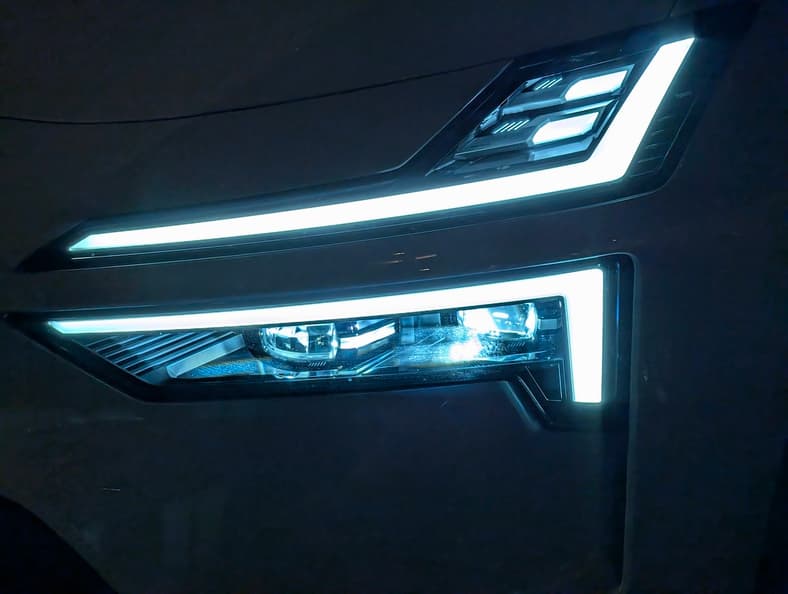
Many people like to use one pedal when driving an electric car, which means that your accelerator acts to both speed up and slow down the car, but I prefer to use two pedals just like when I drive a gas-powered car.
In both one and two pedal mode, the pedal mapping and brake blending is beautifully done making the transitions effortlessly even and contributing to a relaxed, responsive drive.
The Big Story In the Polestar 4: Screens, Lights and HBO Max
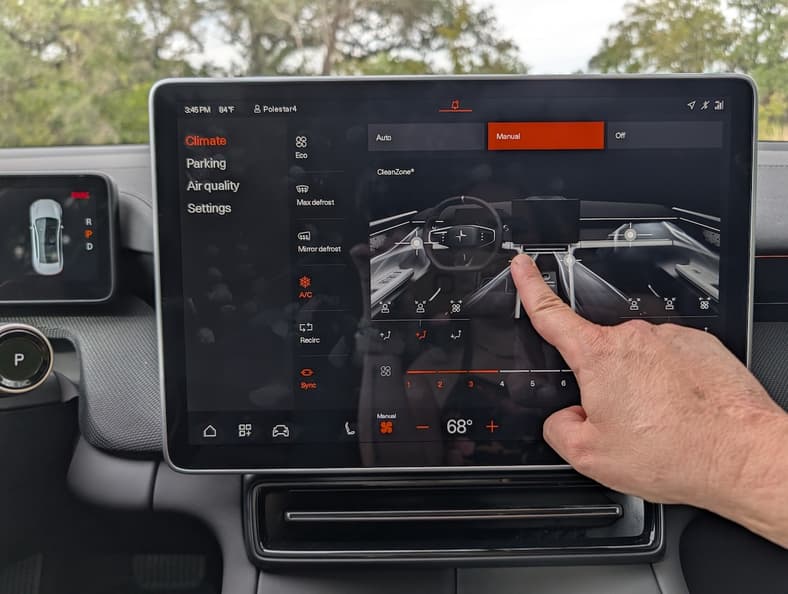
The Polestar 4 is a really screen-dependent car. In order to adjust the air vents, you have to do it on the 15.4″ center screen. Want to open the glove box? You have pop a button on the screen. Set the cabin temperature? Track your energy use? Change the radio station? You got it: on the screen.
But, fortunately, the software is particularly good. As in, they’ve literally won awards for it. You can touch and drag the screen to expand different sections. You can set up to 6 favorite apps or shortcuts so switching on one pedal driving or opening the glove box can always be right there.
That kind of flexibility and customization really helps make it feel like you can mold your car to fit you and makes up for the lack of buttons, which I’m a personal fan of. That flexibility extends to the instrument cluster where you can switch between 3 screens, my personal favorite being map mode that gives you a close up of your location or directions. You can also add an optional heads up display, if you want all the screens, which I kinda do. And, when you’re parked you can connect to HBO Max and stream Game of Thrones on the awesome center screen.
Hey Google, Navigate to Starbucks—and Take the Fastest Lane?
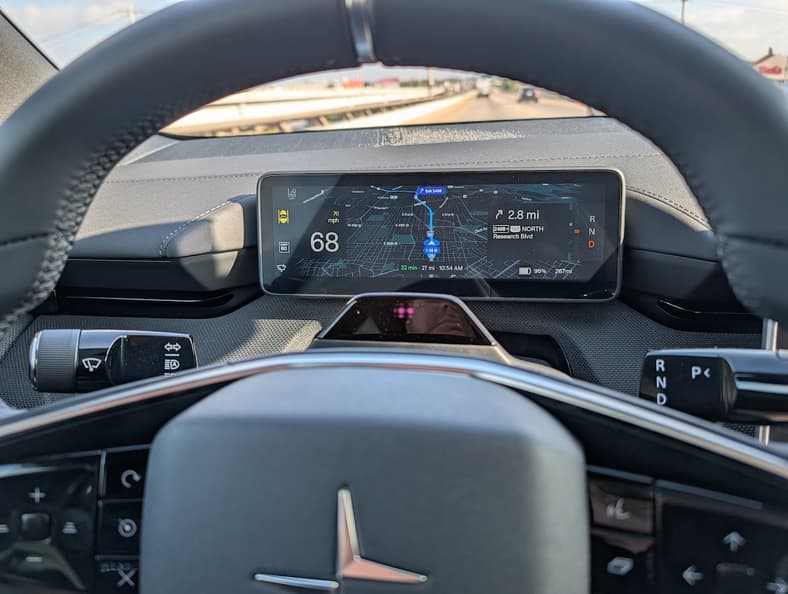
Polestar uses Android Automotive for the operating system, which is Google Built-In (but you can still use Apple CarPlay if you choose). One of the cool bonuses of the partnership with Google is that Polestar is officially the first automaker to integrate Google Maps Live Lane Guidance directly into the driver display of the Polestar 4.
It uses a combination of the forward facing cameras and Google’s advanced AI to analyze the entire road, detect which lane the car is in, and deliver audio and visualization cues to highlight all possible lanes for the chosen route, help drivers change lanes in time, and provide a new navigation experience that reduces driver stress.
Just Because There’s No Rear Window Doesn’t Mean You Lose Visibility
Now, onto that controversial rear window. To address the missing glass, the Polestar 4 utilizes a digital rear view mirror, something we’ve seen in cars for a while now and that we like when the car is full of people or stuff.
Instead of reflecting the view it projects a crystal clear, expansive video view unimpeded by headrests or the back of the car. I thought it would be difficult to shift my focus on the video image then onto the road in front of me, but honestly I got used to it in no time flat.
In fact I found the lack of a rear window to be mostly a non-issue except for one specific situation. When riding as a front passenger, there were a couple moments where we passed a vehicle that I turned to look back at but, of course, I couldn’t see anything. As the driver, you could look at the digital rear view mirror but, as the passenger, you’re kind of blocked off. It was an odd feeling but really limited to that specific situation.
An Interior That Simply Delights With Light and Magic
Sustainability and custom crafted materials are built into the Polestar DNA from the beginning. It’s not performative. Polestar’s designers know their vehicle is more premium and expensive and that their customers have high expectations. This allows the design to be uncompromising in quality and ethics.
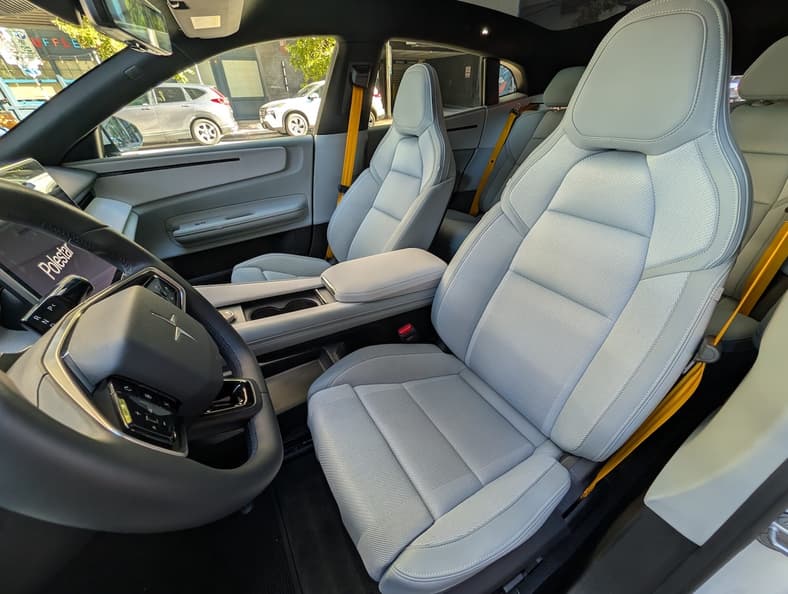
One place that this idea plays out is in the leather interior option—something that many EV makers forgo in the name of sustainability. But using ethically sourced leather from a facility in Scotland that acquires all the hide as a byproduct of the meat industry, Polestar can deliver leather in a way that looks and feels great. Their supplier can literally trace the material to the specific cow it came from.
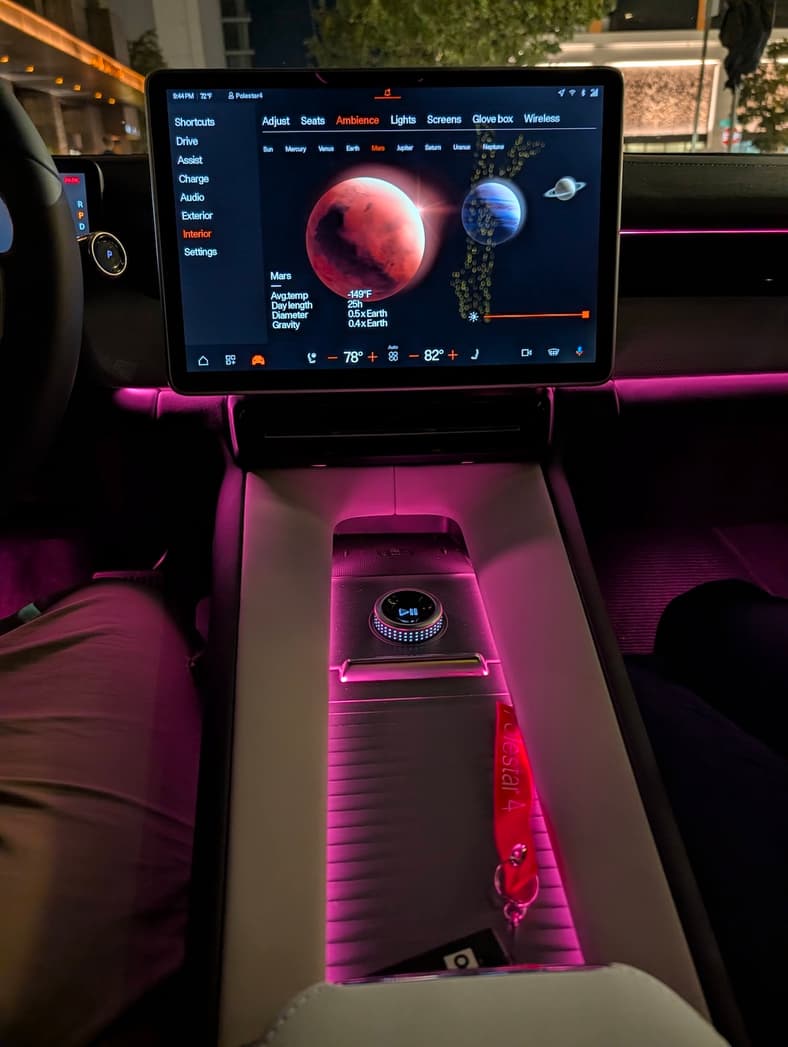
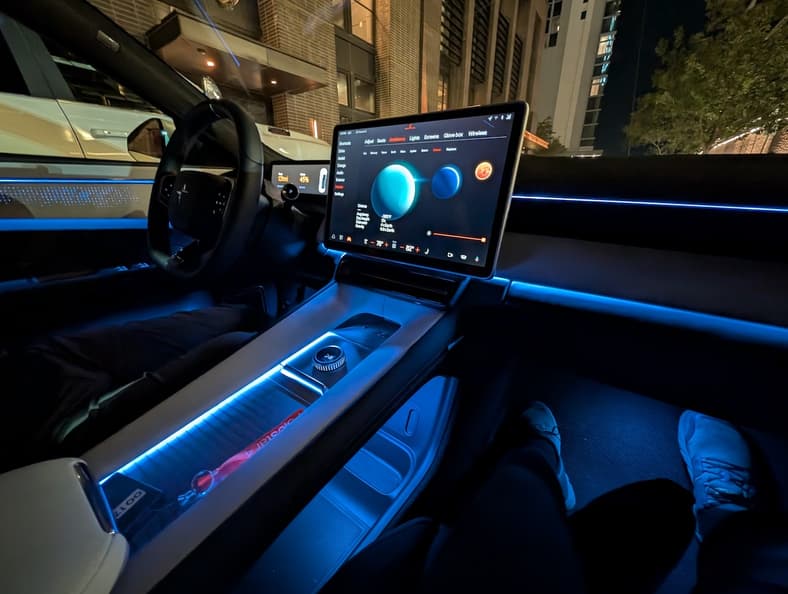
Like many things that Polestar does, the ambient lighting is intentionally curated too, with a solar system of color options based on the planets. I cannot overstate how gorgeous this looks, especially when paired with Polestar’s materials like Tech Knit, a mostly recycled plastic material used on the doors and dash and allows light to shine through. It takes the ambient lighting to the next level.
In all, like your well-dressed friend, the Polestar 4 carries itself with quiet style and an unpretentious yet premium air. Packed with performance and a spacious cabin, it’s a responsive and consistent ride that’s well-refined and a pleasure to drive. It may lack a rear window but, if you’re like me, you’re probably not going to miss it. Ultimately, the Polestar 4 proves that sometimes, the most sophisticated design move is not what you add, but what you take away.

More About:Car Reviews